Skip to content
AppLovin (APP) Intrinsic Value: Stock Valuation
By: Kyle Grieve
AppLovin is a compelling business right off the bat for one reason: Where else can you find a business compounding its earnings per share in the triple digits over the last five years, but trades at a discount to the market’s multiple?
These types of opportunities just don’t happen regularly. But the opportunity exists today, and my job today is to help you understand why. Because, yes, the market can be wrong, and as a matter of fact, is wrong very regularly. But as the market has proven, it’s mostly efficient.
So the question is whether AppLovin is a growth story on sale or a business facing looming disruption.
Let’s get into it!
OVERVIEW OF APPLOVIN: A GROWING COMPOUNDER AT A 50% DISCOUNT
The List of Losers
I have a habit that you, as a value investor, may also share. Every now and then, the cheapskate in me pulls up a list of stocks that are trading closest to their 52-week lows; the same way some people will stroll down the clearance rack at a hardware store. Most of what I end up finding on that list is junk.
We’re talking about melting ice cubes, companies drowning in excessive debt, or businesses whose best years were before COVID. Picture something like the Kraft-Heinz Company, and you’d be on the right track.
So when I came across AppLovin recently near the top of the list, I assumed it would conveniently fit into that bucket. But instead, I was pleasantly surprised. Because AppLovin isn’t a melting ice cube. Its revenue just grew by 53% year over year. It’s not drowning in debt; they barely have any, and they throw off cash like a busted fire hydrant. On top of all that, you can argue that this business still has many good years ahead of it.
Yet strangely, the stock is down over 50% this year.

This is the exact type of opportunity us value investors salivate over. A great business with a broken stock. When looking for new opportunities, this is primarily what I’m looking for: a growing business that continues to operate profitably while the market loses its mind over something I deem temporary or even irrelevant.
Enter AppLovin
The AppLovin Business Model?
Imagine, for a second, you’re playing a Solitaire mobile app on your phone as you kill some time on a weekend. You finish a hand, but before the next one is dealt, a 30-second ad pops up. The ad could be anything from a clip from another game to a mattress company to a meal kit delivery service. That ad didn’t come free. An advertiser paid the mobile game’s owner for that ad slot.
AppLovin is the business that matches advertisers who want to pay to have their ads seen, with publishers (mobile game developers) who want to sell ad slots to monetize their games, while AppLovin takes a fee for brokering the transaction.

So think of it like this, AppLovin really has just two customers:
-
Advertisers, often referred to as the demand side
-
Publishers, often referred to as the supply side
There are, of course, a few nuances here. First is the scale. The total advertising spend flowing through AppLovin exceeds the combined revenue of Pinterest, Snapchat, and Reddit. So this isn’t some small niche business. Second are AppLovin’s margins, which simply outstanding, with FCF margins of 66%.

AppLovin is well positioned to continue printing cash. They don’t own the ad inventory, and they don’t own the game studios. They are almost like a toll booth on a very busy bridge, collecting money from everyone who passes by. The only difference is that there is more than one toll bridge people can cross.
At its bare bones, AppLovin is really four different products. First, and most importantly, is the AppLovin Ads Manager (recently renamed from Axon). This is the part of the business that serves the advertisers.
Second is MAX, the product that helps publishers optimize what they get paid for their ad space. The third and fourth, and less relevant, parts of this business are Adjust, which helps advertisers better understand which ads work best, and Wurl, a streaming TV business that helps content companies launch ad-supported channels.

But before we get into the details of this dual-sided ad tech business, I think we should better understand the company’s DNA.
An Act of Serendipity
AppLovin’s founder-CEO is Adam Foroughi. And he has a pretty good track record of success, as AppLovin is his third advertising-related technology company. So when it came to creating AppLovin, it wasn’t his first rodeo.

The story begins in 2011 when he launched an app that simply told you what mobile games your friends were playing. Let’s say your friend was playing “Words With Friends”; it would then nudge you to play it with them. Adam said the app stunk, but the recommendation algorithm underneath it was actually really strong.
Foroughi noticed that once the recommendation algorithm told someone to play a game with their friend, it generated a ton of conversions. That was the part of the app that mattered, and the part that has stuck around and helped create AppLovin’s recommendation engine. On AppLovin, though, that engine matches advertisers with publishers instead of friends looking to play a game together.

Once Adam figured he was onto something with this recommendation engine, he needed to raise money. He ended up turning to angel investors, who invested about $25 million.
The Pros and Cons of A Board of Directors
For six years, AppLovin operated without a board. I’ve spoken with enough investors and board members to know that a board mostly exists to talk someone out of their best and worst ideas, in roughly equal measure. We saw this on full display with Foroughi and AppLovin:
-
Pro of Having No Board: In 2015, AppLovin was quickly approaching the $50 million EBITDA mark. A potential buyer approached him and offered $600 million in cash for the business. Adam turned it down, hoping to get a billion-dollar valuation. He felt that if he had a board at this time, it would have tried to convince him to sell the business. Keep in mind that, even with a 50% haircut in share price, AppLovin is worth $107 billion today.
-
Con of Having No Board: In 2016, a group of Chinese investors approached him again, this time wanting to buy a stake at a $1.4 billion valuation. Later, it turned out the buyer was partially state-owned. So regulators stepped in on national security grounds, and regulators blocked the deal a year later. Adam felt a board could have told him to just say no and ignore the time and energy wasted trying to get this deal to the finish line.
The Two-Sided Machine
I want to revisit the dynamic that AppLovin plays between advertisers and publishers to make it as simple as possible to understand.
On the advertising side, imagine you run marketing at Wayfair, the business that sells a medley of furniture. You are tasked with one job: turn ad spend into revenue dollars for Wayfair. The number you are laser-focused on is return on ad spend, or ROAS. You are tasked with achieving a ROAS of 500%, meaning that for every $100 of ad spend, you need $500 back in cold, hard sales.

Years ago, if you wanted to achieve this ROAS, you’d build an audience list, guess at who you wanted to target, run the ads, and adjust accordingly. But with AppLovin Ads Manager, you simply set a target and let its algorithm do all the heavy lifting. The matching algorithm searches for users who will meet your targets, and the price you pay scales dynamically with the value of the customer it finds, recalibrating with every new set of data.
The other side is to look at things from the publisher’s perspective. Instead of being a well-known brand seeking to drive sales, we are now, say, a game developer looking to monetize our game. Our game has multiple levels, and we’ve fine-tuned the difficulty to maintain high user retention. Meaning we may have millions of daily active users on our game, and between each level, we have a 30-second ad slot to sell.
Traditionally, if I wanted to drive sales on these ad slots, I’d use waterfall approach, where you rank the ad networks by who historically paid the most. Maybe that’s Google first, Meta second, and AppLovin third. When a slot opens, you contact Google and tell them the price you want for the slot.
If Google declines, you call Meta, and if Meta says no, the request tumbles down the list like water down a waterfall — the first one to say yes gets the slot.

But there are a few problems with this structure. First is wasted time. As the request trickles down to the next advertiser, the slot sits empty. And empty slots pay nothing. Second, money could be left on the table. If the company that traditionally pays the most wants the ad slot, they can get it, but perhaps a lower-ranked advertiser was willing to pay more. In that case, the publisher isn’t optimizing for the highest price.
This is where AppLovin’s MAX product comes in. Instead of using this waterfall, the process becomes an auction. If an ad slot opens, MAX will ask to allow all advertisers to bid on it. MAX will then match the publisher with the highest bidder, resolving the problems with the waterfall.
And the process works! Tripledot, a gaming studio, ended up switching to MAX and A/B testing it across their entire portfolio of games. MAX raised average revenue per daily user by 20%. A 20% revenue gain from simply picking MAX is a pretty nice growth lever.
The AppLovin Flywheel
Thanks to the strong results it delivers on the supply & demand side of programmatic digital advertising, the stock has risen meteorically post IPO, with shares compounding at 34% annually going back to 2021. Even better results were obtainable for those who snapped up shares at the 2023 low point, delivering a 30-bagger in just a few years’ time.

We just covered the auction AppLovin runs on the publisher side. On the advertiser side, it does something similar, too, determining how much an advertiser needs to spend to achieve a specific outcome. But part of AppLovin’s power is that its algorithm sees what not all advertisers can: how their ads actually perform across a large share of the mobile gaming world in real time.
More data from AppLovin Ads Manager and MAX improves AppLovin’s ability to match even better. And better matching means advertisers get a higher return, making them more likely to pay more to be there. If advertisers spend more to get a better return, publishers make more money as well, attracting more gaming studios.
As more publishers join, AppLovin gets even more access to data, and the flywheel keeps spinning.

In theory, this means AppLovin can take a larger share of the profits without squeezing anyone. My best guess is that, on average, they’re taking about 40% of the difference between what an advertiser pays and what a publisher receives. But if the algorithm keeps improving, the gap between those numbers could widen even further.
AppLovin’s Adventures In Game Studios
For quite a few years, AppLovin owned a bunch of game studios. But given AppLovin’s business model, that seems kind of strange, doesn’t it? After all, game studios require a lot of money to run. It would be like Uber buying a bunch of cars to facilitate ride-hailing, rather than relying on contractors to bring their own vehicles.
The real reason for owning gaming studios was to embrace their customers’ perspective on the supply side, receiving feedback and data that could be used to improve the core business.
By 2025, the algorithm was good enough on its own — AppLovin no longer needed the game studios, so they parted ways with them. They received $800 million in cash and stock, keeping a 20% stake in Tripledot to ensure the MAX relationship stayed intact. So the strategy here was to buy the data source, extract value, then sell the shell and keep the data. Kind of similar to what Foroughi did with the matching algorithm.
Numbers That Impress
I haven’t spent much time looking at AppLovin’s numbers yet because I wanted to make sure you undestood the business model. The numbers, though, speak for themselves:
-
EBITDA margins over 79%
-
Revenue per employee is more than $7.6 million
-
Returns on invested capital exceed 110% and are rising
-
In the first half of 2026, they spent a pittance, $1.8 million, on property and equipment. In those same six months, they generated $2.1 billion in cash from operations.
-
Their balance sheet looks quite strong with only $400 million of net debt, and maturities stretching to 2054. With a few months of cash flow, they could extinguish the net debt entirely.

From a capital allocation standpoint, this business stands out not just for its sky-high ROIC but also for its buybacks. It’s weird to associate a technology business with creating value from buybacks, as it seems to be an oxymoron. But in AppLovin’s case, they are the exception to that rule.
The first phase was spectacular, as they bought AppLovin stock at a fraction of today’s price. In 2023 alone, they spent about $1.4 billion on roughly 41 million shares that are now worth $12.6 billion. This is the capital allocation that value investors can only dream of!
I break down the buybacks into two separate periods. The second chapter, spanning from 2025 to now, remains unresolved. They’ve spent over $2 billion on shares that are more than 30% above today’s price, so not so good. But I don’t think we can properly grade them until the market decides whether this business can continue to grow.
So Why The 50% Haircut?
With numbers like these, the 50%+ drop in 2026 doesn’t make sense, not if you’re just looking at the numbers, anyway. Q2 earnings dropped in August, and they still looked pretty solid with revenue up 53% and profits up 55%. And since that time, the stock has fallen nearly 30%.
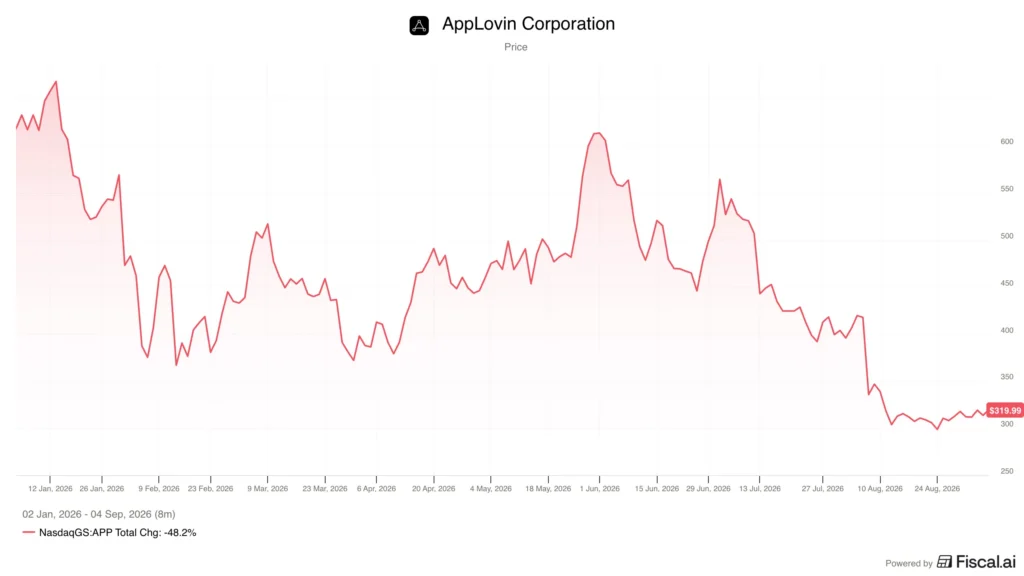
There are three things that did it:
-
A slight revenue miss of just $20 million or 2%. I think this is pretty irrelevant
-
A reduction in guidance. They’re still guiding for 46%-48% growth in Q3, but the fact that it’s decreasing spooked Wall Street.
-
Margin guide-down.
I’d say the last two are the primary culprits. Wall Street tends to like businesses with accelerating growth rates. And even though AppLovin’s growth rates remain exceptional, I think there are real questions about how quickly these numbers may decline in the coming years. Put yourself in investors’ shoes for a second. You paid a growth multiple. Now growth is decelerating, margins are compressing for the first time ever, and volume has turned negative. I know I’d get a little nervous too.
Future Growth Levers
The above may concern you, and I wouldn’t blame you, but we need to evaluate whether this company can continue growing. The days of growing revenue by 60% or more seem to be over, but that doesn’t mean this company can’t still grow and make cash. I see three primary growth drivers.
The first is e-commerce. E-commerce has grown for them, but there’s a small issue as it’s not the best natural fit. AppLovin generally shows 30-second ads inside mobile games. But most smaller e-commerce businesses tend to build static images and product catalogues for Google or Meta. If AppLovin can bridge the gap, it will do very well, but it’s not yet clear whether they can.
The second is Gist, a social media app they built from scratch. With Gist, they are copying the gaming studio playbook and trying to gather data on where users spend time to then use for the flywheel. But I’m not expecting this to be the next Instagram or TikTok, so who knows how much of a value-add this will be. Lastly, it is expanding beyond games into non-gaming apps, the open web, or connected TV. This doesn’t appear to be a priority right now, but there is upside optionality here.
Prefer to watch? Click here to watch this episode on YouTube.
APPLOVIN’S INTRINSIC VALUE
My base case for AppLovin is conservative. Over the next five years, revenue will compound at 17%. Keep in mind management just guided for 47% in the near term, so I’m pricing in a lot of further deceleration. Next are EBITDA margins, which I simply kept at about the same level they currently have, 77%. I then apply a 13x EV/EBITDA multiple and a 30% margin of safety. That gets me to a value of about $483, a 9.4% annual return from today’s price.

Download the model and adjust your assumptions
The returns here look pretty good. If management can maintain or slow the deceleration in growth, this estimate will end up being way too conservative. But I just can’t get conviction in that outcome. On top of this, the business’s disclosures are very weak. This tells me they don’t want to tip off competitors about what they’re prioritizing. While this makes sense from a business standpoint, it doesn’t help educate potential investors like me. So even though the business is cheap, it’s not an investment we’d ever really feel comfortable with.
What would change my mind is if volume started picking up again, or if the business decided to share more information in its disclosures. While I think these are very low-probability events, they would at least give me some extra insight into where the company is headed.
(Disclaimer: The Intrinsic Value Portfolio is a portfolio of high-quality, long-term stocks built out weekly by our hosts, Shawn O’Malley, Daniel Mahncke, and Kyle Grieve. To track the portfolio, sign up here.)
About The Author
Kyle Grieve: Kyle Grieve is one of the hosts of The Intrinsic Value Podcast where they break down and values different business every week.
Kyle Grieve
Kyle Grieve is one of the hosts of The Intrinsic Value Podcast where they break down and values different business every week.
OUR COURSES