Skip to content
Alternative Investing in Rare Earths and Strategic Metals
In alternative investments, you hardly ever hear about something brand new and exciting. Rare earth elements and strategic metals are emerging assets which are still extremely niche, not correlated with the broader financial markets, and are pretty much the center of news nowadays.
Some obscure-sounding metals like indium and gallium are pivotal to industrial manufacturers with the most groundbreaking tech, but investor interest in these materials hardly exists, even though their prices have climbed dramatically in recent years, far outpacing many traditional assets. The reason for that? Investors are unaware that they can tap into those markets, and are afraid of taking the first step.
This article is intended to explain the why and the how of investing in rare earth metals, why they seem to be promising, and what’s the advantage and disadvantage of buying into such a niche product which requires overhead in the form of storage.
TABLE OF CONTENTS
I. WHY RARE EARTH METALS ARE A GROWING INVESTMENT OPPORTUNITY
II. PHYSICAL METALS VS. STOCKS – UNDERSTANDING THE DIFFERENCE
III. THE INVESTMENT PROCESS
IV. POTENTIAL RISKS AND CONSIDERATIONS
I. WHY RARE EARTH METALS ARE A GROWING INVESTMENT OPPORTUNITY
Rare earth elements (for example: neodymium, dysprosium, terbium) and strategic “technology metals” (for example: gallium, germanium, indium, etc.) are de-factot the building blocks behind technology. They are the very foundational materials of some of the most boming sectors in the global economy and the main growth drivers in 2025, including, but not limited to – clean energy, semiconductors, telecom, and defense.
For instance, gallium and germanium are essential for semiconductor chips and fiber optics manufacturing, while indium is used in virtually every touchscreen display, and rare earths like neodymium are critical in order to produce high-power magnets.
Surging demand coupled with constrained supply is what makes these metals especially interesting as investments. Many strategic metals are by-products of other mining (e.g. gallium from aluminum bauxite, indium from zinc mining) and are produced in highly limited quantities.
In addition to that, over 80% of global refining capacity for rare earths and tech metals is concentrated in China, which weaponizes its unique standing to improve its superpower status. Geopolitical export restrictions and resource nationalism have already begun to squeeze availability of these materials, while demand rises significantly as the AI tech boom is in full motion.
As a result of that, throughout 2025 the strategic metals market saw remarkable gains. Indium is up more than 20%, Gallium is up more than 50%, and Germanium is up 70%.
As China has tightened export controls on critical minerals starting in 2023, overseas supplies of gallium and germanium temporarily dried up, and haven’t improved since. At the same time, manufacturers of EVs, solar panels, and high-speed electronics have began stockpiling those materials. In 2025, China has added additional restrictions on Rare Earth Materials, sending the whole market into a spin.
The USA, the UK, the EU and Australia have all begun attempting to self-produce some of those materials to decrease their reliance on China, but analysts note that establishing new mines or processing facilities will take years, meaning the market is likely to remain tight in the near future.
II. PHYSICAL METALS VS. STOCKS – UNDERSTANDING THE DIFFERENCE
Given that strategic metals seem like a very solid, anti-inflationary, investment, many would seek out the standard investment avenues here. And by that, it means purchasing stocks or ETFs that deal with rare metal mining. There are publicly traded rare earth mining stocks (like MP Materials in the U.S. or Lynas in Australia) and even a well-known VanEck Rare Earth/Strategic Metals ETF (REMX).
However, it turns out that buying physical metals vs. buying equities/ETFs can lead to very different returns. The prices of metals does not necessarily correlate with the market price for the miners or for ETFs.
Take Gallium, for instance, one of the major metals.
The Gallium price chart (by EarthRarest.com, representing European prices) shows an approximate 20% increase from Dec 2023, to December 2024. Between Dec 2024 and Dec 2025, there is approximately 80% increase.
Let’s take Indium, another highly popular industrial strategic metal.
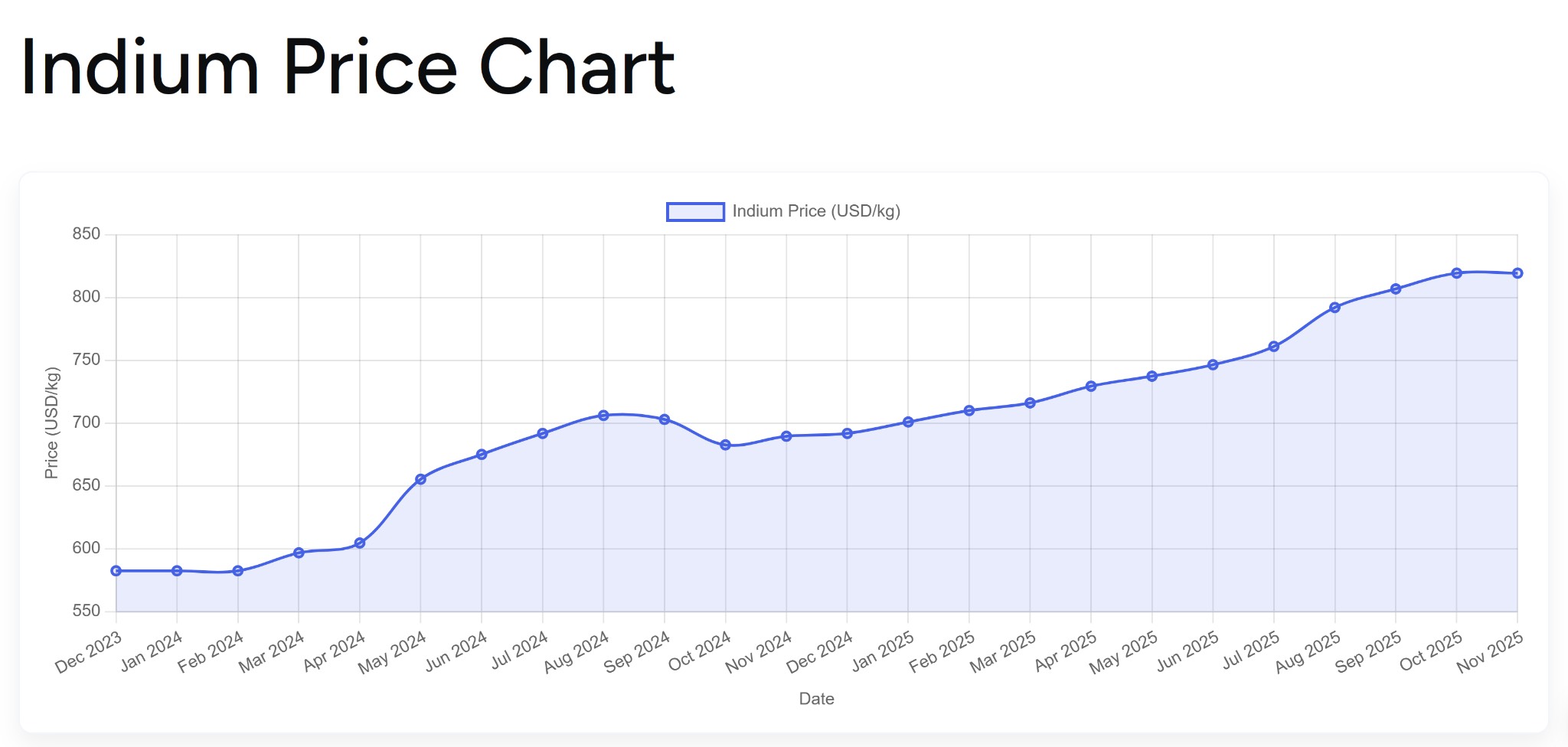
The Indium price chart (by EarthRarest.com, representing European prices) shows around 30% increase between Dec 23 and Dec 24. And then a similar increase of 20-30% between Dec 24 and Dec 25.
Whereas, if you look at REMX and MP Materials in the same period, there is no real correlation at all. Data from Preplexity show that REMX has declined 35% Dec 23 to Dec 24, and gained approximately 67% in 2025. MP Materials, as a result of a DoD contract/ sponsorship, has gained 200% in 2025, after losing 20% in 2024.
The stocks and ETFs are more correlated with the broad market, mining conditions, and government incentives than with the underlying materials’ prices.
Hence, investors who want to speculate on the prices of strategic and rare metals are forced to buy them physically, pay for storage, and enter into a domain that sways away from most peoples’ comfort zone.
III. The INVESTMENT PROCESS TO BUY STRATEGIC METALS
Investing in physical rare earths or tech metals requires going through specialist brokers and dealers, unlike buying a stock or ETF on an exchange. The process, while unconventional, is designed to be safe and transparent, as exemplified by dealers like Earth Rarest.
The investment process typically involves the following key steps:
- Choose Your Metals
- Select the specific rare earth metals (e.g., neodymium, terbium) or strategic technology metals (e.g., gallium, germanium, indium) you wish to own.
- You are purchasing a physical quantity of the metal in high-purity form to gain direct exposure to the underlying commodity price.
- Order
- Place an order through your chosen dealer.
- This involves filling out a simple purchase agreement or order form, including basic identification to comply with regulations.
- Transfer the funds, typically via wire transfer to the dealer’s escrow account.
- Upon payment, you receive legally binding documentation (a title) stating your rights to a certain amount of the metal.
- Secure Storage in a Bonded Warehouse
- The metals are kept for you in a professional, secure, and specialized bonded warehouse (often former bank vaults).
- This storage is necessary because many rare earths (like oxides or ingots) require careful handling.
- Bonded warehouses are generally exempt from VAT (import taxes), and the metal is covered by full insurance and subject to regular audits.
- This provides full physical backing for your investment without logistic worries and maintains a clear chain of custody, which is crucial for resale to industrial buyers.
- Plan Your Exit, Sell The Metals
- Well-established investment programs offer a straightforward pathway to sell your holdings back into the industrial market.
- For example, Earth Rarest partners with a company like Tradium in Germany to buy/sell the metals to end-users.
- You contact your dealer to demand a price, and they handle the sale at the market price (minus a commission).
- This provides a clear exit strategy, liquidating your assets directly to the industry with relative ease.
- Documentation and Costs
- After each purchase, you receive essential documents: a chain-of-custody certificate (proof of ownership) and a stock report.
- Storage costs are typically low, on the order of ~1% – 2% of the metal value per annum, which covers insurance and vault charges.
- The purchase process is more expensive than buying a security due to the steps involved, but working with established specialists ensures transparency.
IV. WHAT IS POTENTIAL RISKS AND CONSIDERATIONS?
Like any form of investment, rare earths and strategic metals come with their own risks and caveats. Investors should enter with eyes wide open for both the pros and cons of a niche asset class, this time with a cautious approach. Here are a few key considerations:
Price Volatility
These metals are known for their price volatility. The market is quite thinly traded, meaning supply shocks or demand surges can trigger sharp increases – or decreases – in price. For example, prices can move quickly in a thin market when export quotas or a new policy comes through. Earth Rarest explicitly cautions that strategic metal markets “are volatile, with prices driven by global supply and demand”. Investors should brace for something like massive swings (as one observes in commodities or small-cap shares). This level of volatility can be a double-edged sword: it creates upside potential, but it also means that prices may suddenly pull back if, for example, a new source of supply is brought online or if a temporary industrial demand softens.
Liquidity and Exit Strategy
Physical metals are not as immediately liquid as stocks or bonds. And while there’s a network of dealers and industrial buyers (so rare metals on the whole are a bit more liquid than most collectibles), you can’t just get them out there, with a single mouse click, in a public exchange. Liquidating involves connecting with your dealer or buyer networks, which may take days or weeks not seconds. Good news is that existing programs have included buyback routes (for example using Tradium) that are integrated with them so that there exists a path to liquidity. But investors should know liquidity is “moderate”: You won’t see daily market bids displayed on an app and big lot sales may require identifying specific buyers. This means lower immediacy – a trade-off for accessing this niche market.
Storage Costs and Logistics
You need to store and secure physical metal when you own it. That adds carrying costs that wouldn’t be incurred with a stock. Storage and insurance fees on an annual basis are about 1 to 2% of the value of the metal. Over many years, such fees start eating into returns, so you have to consider that. There is also the question of trust: The storage provider’s trustworthiness must be proved. Use of well-known bonded warehouses and dealers reduces this risk (with audits and insurance in place), but it’s different from holding a paper asset in one’s brokerage account. Physical ownership also entails tracking your documents: though with professional storage the threat of loss or theft is negligible, it’s not zero.
Unregulated Market
Physical rare earths are not regulated in the financial market — unlike stocks or ETFs, with securities regulators overseeing their trading. These metals are treated from an investment standpoint like physical gold and silver (as commodities/property). They do not come under the purview of authorities such as the SEC and FINRA. Which isn’t necessarily unhelpful (after all, gold isn’t SEC-regulated either), but it’s buyer beware. You have to do your homework on the dealers you partner with, make sure pricing is fair and realize that there’s no government investor protection scheme for rare metals. Established firms help you to establish trust by partnering with companies which are well-established in your industry or by providing third-party verification. Nevertheless, the lack of regulation is a consideration – it places more responsibility on the investor to choose trustworthy service providers.
Market and Sector Risks
Finally, how much of these metals can you have in your portfolio if they do fit together. And that’s what we call concentrated commodity exposure. If the tech and clean energy sectors are doing well, strategic metals could be winners; if there’s a major technological transformation, however, such as a new material to replace indium in touchscreens, or a breakthrough that drops demand for a particular rare earth, that could put downward pressure on prices. Plus, because supply is dominated by some countries, geopolitical risks loom and policy shifts (e.g. China suddenly lifting export restrictions or, conversely, banning additional elements) can whipsaw the market. So many investors see rare metals as a small satellite holding for diversification and some inflation hedge potential, rather than a core portfolio holding. As one commentator observed, such assets can provide “stable, intrinsic value with moderate returns” in the long term, but should complement traditional investment strategies in a balanced manner. As prudent investors will set down position sizes correctly and stay up to date on changes in the industry.