Skip to content
Remittances as an Indicator: What Global Money Flows Reveal About Economic Trends
Remittances are a lifeline for millions of people all over the world, especially in developing countries.
This fact is well expressed by an International Monetary Fund’s (IMF) description of workers’ or migrant remittances as migrants sending home “part of their earnings in the form of either cash or goods to support their families.”
From a much broader perspective, the World Bank defines remittances as “the movement of funds from the country of work back to a home country.”
Broadly or narrowly, these descriptions point to a fundamental narrative: money earned in one country is moving to another country.
You may wonder, how much money is being moved?
In 2023, a total of US$857 billion was sent in remittances globally, with US$656 billion going to low- and middle-income countries (LMICs), according to the World Bank.
For context, that’s more money than the GDPs of South Africa and Egypt (the top two performing African economies) combined.
For the migrants sending money back home, remittances are mostly just about supporting their families with funds to cover basic needs, from shelter and food to education and healthcare. It could also be about supporting their communities or business partners with more funds to boost their resilience.
But for the countries receiving these funds, the socioeconomic impacts are felt across sectors and industries, as their populations’ purchasing power becomes strengthened.
In fact, for some, the remittances become a significant portion of or even the mainstay of their GDP, as with Lebanon, Tajikistan, and Tonga, where remittances were 30.7%, 39.1%, and 40.6% of their GDPs, respectively, in 2023.
Clearly, remittance flows are not just a matter of humanitarian or familial endeavors: they are macroeconomic indicators revealing broader global economic, political, and labor market trends.
Today, we examine some key socioeconomic implications.
First things first, where are most of these remittances coming from, and where are they going?
Remittance Flows
Although remittances flow both ways, some countries stand out as the top sending countries and some others as the top receiving countries.
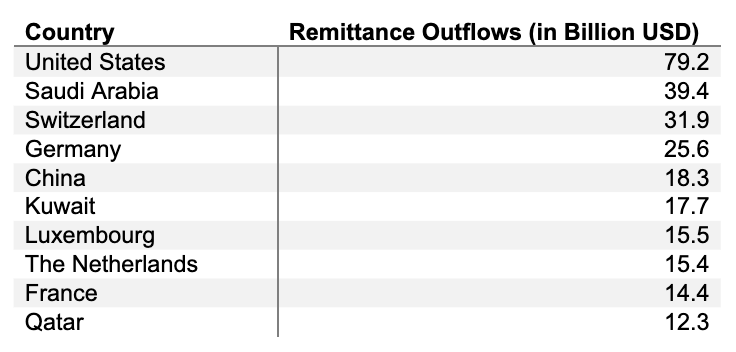
That said, below is a table of the available data on remittance flows according to the World Migration Report.
Major Sending Countries
These are countries that had the most remittances sent out from their economy to other countries in 2022.
For decades, the U.S has maintained its position as the country with the most remittance outflows in the world.
Major Receiving Countries
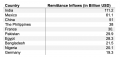
The top 10 countries receiving the most remittances in 2022 were:
Since 2008, India has maintained its position as the top remittance-receiving country in the world. Contrary to popular belief that most remittances flow southwards to LMICs, the remittance inflow data is clearly a mixed bag, with high-income countries like Germany and France making it to the top 10.
Although France is also a top remittance sender, the difference in outflow and inflow shows that it is a net receiver. Same as China (an LMIC), which also maintains positions on both tables.
To better understand the implications of remittance flows, we have to understand the mechanics behind them.
Mechanics of Remittances
With most transfers going to LMICs, remittances have been described as “a hidden force in international development.”
Behind this force is a fast-growing global remittance market, projected to cross $1 trillion by 2029. This is a market primarily founded on the large-scale digital disruption that reshaped the global finance industry in the past two decades, with a surplus of international money transfer services and other fintech innovations.
As a result, there has been a significant shift in how remittances flow across the world.
For starters, migrants are moving from traditional banks to relying on international money transfer platforms for all their cross-border transfers.
What’s behind the shift?
The World Bank notes that with an average service charge of 12%, banks remain the costliest channel for sending remittances.
Note that average costs also vary from country to country. With Turkey, for instance, fees could be as high as 56.9% of the transaction amount.
Fintechs, on the other hand, have much lower service charges. Top providers like BOSS Money offer low fees and zero charges on the first transfers, and are fully transparent—customers can check the exchange rates, fees, and the amount received directly on their website.
Besides being cheaper, fintech platforms are also generally faster and have far more delivery options than traditional banks. They can deliver instantly or same day, compared to bank transfers that could take up to 5 business days to get to the recipient.
Fintech providers also work with mobile agents in rural communities, offering services like cash pickup and home delivery to unbanked and underbanked communities.
The level of disruption brought on by fintechs is a key motivator encouraging migrants to be more comfortable with sending money back home, without fear of outrageous and hidden charges, slow deliveries, or the money not getting to their loved ones at all.
Consequently, the global remittance market has maintained a steady growth over the years.
What Remittance Trends Reveal
Remittance flows go hand in hand with some major socioeconomic trends, and we’ll examine them below:
Migration and Labor Market Dynamics
Remittance trends are often embedded in migration reports, sometimes as an indicator of migration trends or the performance of migrants across the country.
Take Egypt, Nigeria, and Mexico, for example.
The 2021 countries’ remittance inflow data provided by the International Organization for Migration (IOM) show that:
- The U.S. ($6 billion) and the U.K. ($3 billion) are the top senders to Nigeria.
- The U.A.E. and Saudi Arabia—$8 billion each—are the top senders to Egypt.
- And with over $53 billion, the U.S. is the top sender to Mexico. Canada comes in at a far second with $400 million.
With such remittance data, institutions, organizations, and researchers can safely conclude where a country’s labor force often migrates to or where they do well the most, signaling shifts or consistencies in labor migration patterns.
Economic Health of Host Countries
Remittance data can also be used to express the economic health of a remittance-sending country across various indicators of economic strength, such as employment.
Fundamentally, countries with high remittance outflows generally rank high in terms of employment opportunities.
The capacity to remit is directly related to the job opportunities available in a host country or the host country’s demand for migrant labor force, according to a study published in Applied Econometrics and International Development Journal.
Basically, this means that the stronger the economy, the higher the remittance outflow.
Currency Exchange and Inflation
Remittances can significantly boost a recipient country’s foreign currency assets. With strengthened foreign exchange reserves, LMICs could more readily establish confidence in their local economy, service their international debts, and stabilize exchange rates.
High remittances, on the other hand, can also boost the purchasing power of a section of the population, stimulating economic growth while equally fueling demands and increasingly higher prices, thus contributing to inflation.
Case studies
For better insight into how remittances affect economies, let’s have a quick look at remittance trends in the top two remittance-receiving countries, India and Mexico.
India
India boasts a large population of emigrant skilled professionals earning substantial wages across the globe, especially in the Gulf countries (including the U.A.E. and Saudi Arabia) and the U.S. It also helps that the Indian government has institutionalized money transfer policies that encourage its emigrant population to remit money back home.
Consequently, India has maintained its position as the largest remittance-receiving country since 2008, with over $111 billion in 2022.
Studies show that remittance inflow to India has some significant effects on the country’s exchange rate, inflation, and broad money supply.
Remittances inflows into India also significantly reflect on the country’s GDP and stock returns.
Mexico
Mexico’s remittance inflow is strongly tied to the U.S. labor market and peso-dollar exchange rate. The U.S. is the major destination for Mexican immigrants.
A strong U.S. labor market translates to more job opportunities for Mexican migrants, which results in higher remittances to Mexico.
For context, remittance flow from the U.S. makes up to 97% of remittances received in Mexico, making the remittance relationship between the U.S. and Mexico an interestingly unique case.
A slowdown in U.S. job growth results in remittances to Mexico dropping significantly. This is also the case when the peso gains against the U.S. dollar. In either case, the effects on economic activities in Mexican communities are often visible.
Given the substantial impact of remittances on the Mexican economy, experts suggest that there’s a growing need for remittance inflows to be regarded as a supplemental support for families rather than something to rely on.
Conclusion
Remittances are more than just personal transfers to loved ones abroad—they are real-time economic signals of economic strength, migration patterns, labor market shifts, potential inflation, and currency exchange dynamics.
As the global remittance market continues to grow, we expect more fintech investors to join the game and possibly change how remittances flow across the globe.
For remittance-receiving countries, the potential market growth presents opportunities to implement policies that encourage remittances while equally bolstering the economy.
For senders, a competitive remittance market is a call to look beyond the banks to fintechs that are now offering faster and far cheaper remittance services to ensure that they make the most of every cent sent back home.