Skip to content

Copart (CPRT) Intrinsic Value: Stock Valuation Revisit
By: Daniel Mahncke
It’s not the first time we’ve pitched Copart. In October of last year, the stock was already down 30% from all-time highs, and I decided to take a look at this fallen compounder.
We ended up liking the business a lot, and since we had plenty of capital to allocate back then, we decided to allocate 2% to Copart. As you can tell by the position sizing, we weren’t fully convinced. It wasn’t about the quality of the business, but the price.
Despite the 30% drop, Copart was not a bargain in the mid-40s. The more companies we looked at, the more opportunities we found that seemed to offer a better risk-reward. So we decided to sell Copart in the low-$40s. The stock kept falling, which makes that decision look smarter than it was. For us, it was just about opportunity cost.
But things have changed. Copart is trading at $32 a share; it’s buying back stock in size, and Jay Adair is returning as CEO, but its main competitor seems to be gaining market share.
Let’s dive in!
COPART: THE CASE FOR BUYING IT AGAIN?

The Wrath of Decelerating Growth
Let’s first figure out what happened to Copart since our first pitch. And I would like to start by zooming out a bit. Copart’s revenue growth rate has slowed from the mid-teens to basically nothing in the last two years. That explains a lot of what’s happened to the stock.

In the episode on our biggest losers, slowing top-line growth kept coming up. Investors can get so attached to a company’s “quality” that they underestimate what happens when the growth disappears. Over the long run, revenue growth is the best predictor of where stock prices go. Thus, it’s not surprising to see the high correlation between Copart’s growth in the last two years and its stock price.
Stock price collapses can be all the more dramatic when a business’s valuation multiples were already high. That was undoubtedly the case for Copart. Shares had long benefited from Copart epitomizing many investors’ hunts for high-quality, boring compounders.
That said, Copart has seen times of decelerating growth before. It is a cyclical business after all. Revenue growth stalled in 2015, too, without being fatal to shareholders. Copart eventually recovered, and earnings per share continued growing even despite the revenue volatility. Although earnings are currently under pressure, too, based on the latest earnings report.

But when we zoom in, there are some deeper problems that Copart is currently trying to address. Otherwise, ex-CEO Jeff Liaw wouldn’t have been replaced by Jay Adair. Copart is known for long CEO tenures, not for abrupt changes or for bowing to Wall Street pressure.
In the introductory call Jay Adair gave, he made clear that he believes Copart is in much stronger shape than the narrative suggests, but it also seemed clear he thought it needed better management in certain areas.
Today, we wanna find out whether this is just a cyclical trough or whether Copart’s business and the industry around it have changed.
Copart – The Business Explained
To answer the above question, I should first briefly clarify again what exactly Copart does. I don’t want to assume everybody read the prior pitch and knows exactly what’s going on.
Copart connects insurers trying to dispose of totaled cars with buyers around the world. Those buyers might dismantle a vehicle for parts or repair it and put it back on the road.
In its core business, Copart doesn’t own the car. It handles the towing and storage, photographs the vehicle, takes care of the paperwork, and runs the auction. For those services, it earns fees from both sides – the sellers and buyers.

Copart Online Auction Platform
Since the supply starts with an insurer deciding whether to repair a damaged vehicle or write it off, Copart cares a lot that cars keep getting totaled. The share of accident claims ending in a write-off is called total loss frequency.
When Adair started at Copart about 35 years ago, the total loss frequency was 8%. Today, it’s almost 24%. That means 24 out of 100 cars that crash and go to insurance companies are categorized as totaled and sent to Copart or a competitor.

That might sound odd when cars keep getting safer. But the technology making them safer also makes them expensive to fix. Damage to a bumper can mean replacing sensors and recalibrating the systems behind them. You no longer need a catastrophic accident to end up with an uneconomic repair bill.
Teslas, for example, are some of the most modern cars on today’s streets, and you’ll see many photos of “totaled” Teslas that don’t immediately look all that totaled. But once cameras and sensors are hit, it rarely makes sense to repair them.

Interestingly, Copart actually helps drive total loss frequency higher. As former CEO Jeff Liaw explained, every additional dollar recovered at auction makes writing off a car more attractive for insurers. In that sense, Copart competes with the repair shop for the right to resolve the claim.
That also helps explain why the buyer network is more than a convenient place to sell cars. If an insurer can reliably recover more money through Copart than through competitors, that’s the best argument there is to choose and stay with it. And Copart benefits from more vehicles arriving, as well as higher prices on the vehicles it already handles, since seller fees are often based on the so-called Percentage Incentive Program. Meaning Copart receives a percentage of the sale price.
But buyers are the ones who pay the majority of the fees in Copart’s transactions – about 80%. The fees typically range from 8-13%. The reason is simple. There are only about a dozen insurers of size, which means they have plenty of negotiating power, while Copart’s buyers are highly fragmented. So Copart doesn’t want to overcharge on the insurance side, which ultimately delivers volume to Copart in the first place.
But this insurance service revenue isn’t Copart’s only business. Vehicle sales account for the other about 15% of revenue. Here, Copart buys cars outright and resells them, often in international markets where the service model hasn’t caught on yet. The idea is to demonstrate the auction’s liquidity and eventually move customers onto the higher-margin fee model.

Germany is a good example because its model differs significantly from the U.S. service model. Traditionally, the insurer pays the replacement value minus the wreck’s residual value, leaving the policyholder to sell the wreck. That’s an annoying job to inherit after an accident. It also creates opportunities to repair damaged cars cheaply abroad and resell them without proper disclosure (as discussed in our Auto1 episode).
After proving to German insurers that Copart’s model is superior, it persuaded some of Germany’s biggest insurers to adopt its service model. And with less than 10% market share and no real competitor, it should have quite a long runway.
And the economics of the service model are much more attractive than the vehicle sales model. In 2025, international service revenue was up almost 20%, while vehicle revenue was dropping close to 20%. That drove international EBIT up 50% year over year.

The Moats Still Exist
I joked to Shawn in our episode that even people who have never researched Copart know one thing about the company…It owns its land. That is a popular speaking point for enthusiasts pitching the stock.
And while it feels repetitive to bring it up every single time, it’s way too important to skip it. Copart owns over 250 locations globally. Its main competitor, IAA, primarily leases its yards. But suitable land is scarce, and getting permission to turn it into a salvage yard isn’t easy. I wouldn’t be excited about one opening next to my house either (if I had one).

Ownership gives Copart control over locations it may need for decades. It also avoids the risk that a landlord wants to put the land to another use or leverage their power by raising the rent.
On another note, Adair recently said Copart now has enough land that it no longer needs to spend $500 million a year acquiring more. That’s quite a sizable amount of money that can thus be saved going forward. Last year’s free cash flow was $1.2 to $1.3 billion. Even cutting that land spending in half would make a meaningful difference.

Progressive Is Changing the Share Picture
For a long time, owning the land, being willing to forgo short-term profits to help in times of crisis (for example, when Hurricane Katrina happened in 2005), and having a highly capable and rational management team helped Copart gain share from its main competitor, IAA.
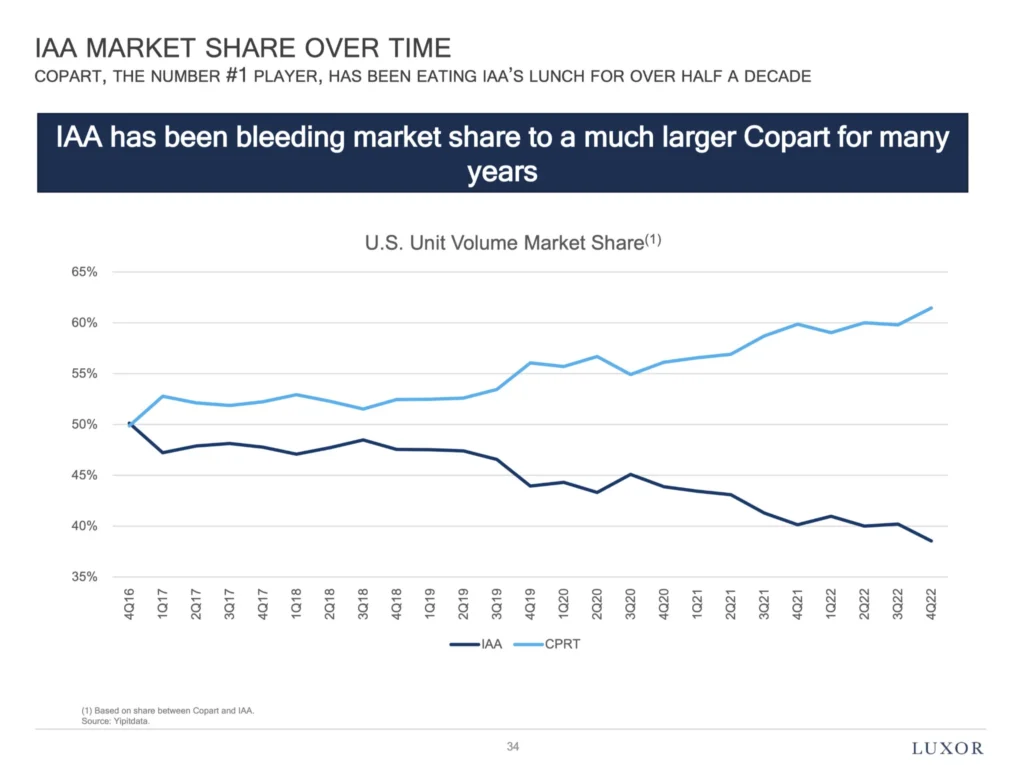
However, that dynamic has changed recently. First, IAA has narrowed the capacity gap. About 5 years ago, Copart had roughly 70% more land capacity. Now it’s closer to 25%. Of course, leasing makes expansion easier, and ownership offers longer-term advantages, but IAA still did a good job closing that gap.
But the main issue is not that IAA managed to increase its land capacity. The main issue appears to be Progressive – one of America’s largest car insurers. In fact, S&P estimates that Progressive recently became the largest. And Progressive is a long-time IAA customer.

Insurers can split their volume between auction providers, which helps preserve alternatives and negotiating power. Typically, insurers favor Copart, allocating something like 75% of volume to it and 25% to IAA.
Progressive has historically leaned the other way, sending three-quarters to IAA. I’ve even heard that it recently moved as much as 90% there. So Copart gets hit twice: Progressive favors IAA, while insurers that favor Copart are losing customers to Progressive.

But why does Progressive favor IAA in the first place? Well, the two of them have a longstanding relationship, and IAA gives Progressive priority service, including faster pickups and better storage placement. Most importantly, it appears willing to accept low margins on that business.
My reading of some of Adair’s recent comments about volume loss was that Copart chose not to match those economics. He didn’t mention Progressive by name, but he talked about not taking business that doesn’t fit Copart’s economics, and since Progressive seems to be the only lost volume, these comments may have been aimed at them.
And if you read carefully, there are two interesting things I just mentioned, or at least implied. First, Progressive is supposedly the only insurer that shifted more volume to IAA, so it’s not an industry trend. Second, you might think Copart could be overcharging. If Progressive is getting a better deal at IAA, why wouldn’t other insurers follow?
To answer that, we should look at the margins and why they differ. Copart’s auto segment margin is 36%, while IAA’s is likely below 20%. We can’t know it precisely since we can only look at the financials of IAA’s parent company, Ritchie Bros.
After reviewing those filings, much of the difference appears to reflect acquisition-related depreciation, stock-based compensation, and land leases. It doesn’t establish that Copart is overcharging. So IAA can’t profitably undercut Copart by much, and it can’t give every insurer the same priority treatment to sweeten the deal either.
I guess this is what Jay Adair refers to when saying that the dynamic between Copart and IAA hasn’t really shifted and that Copart remains the superior business. IAA can win volume because an insurer already favoring it grows faster, but that doesn’t take anything away from Copart’s auction liquidity, cost structure, and trust with other insurers. So I take some comfort that the losses are apparently concentrated in one relationship and the liquidity moat is still intact.
Expensive Insurance is Shrinking Supply
But if the competitive threat is not as big as it seems at first glance, then why are volumes down so much? Well, that’s where the cyclicality problem comes into play. Between 2020 and 2025, average U.S. full-coverage premiums rose about 55%. Insurers responded to higher repair costs and vehicle values that made underwriting unprofitable.

Some drivers opted then to switch to liability-only coverage or raise deductibles. Others totally stopped insuring their cars (which is illegal, by the way). Given these circumstances, if an accident occurs, the driver has no insured claim for their own vehicle, so it doesn’t enter Copart’s usual supply channel.
About a third of American drivers were uninsured or underinsured as of 2023, up about 10 percentage points from 2017. CCC found that uninsured or underinsured motorist claims nearly doubled as a share of third-party claims over three or four years, reaching 16% at the end of last year.
CCC also estimates that about a quarter of repairs are self-pay. It’s even launched a buy-now-pay-later product for those customers, which gives you an idea of the demand.
Copart’s own data also shows more cars on the roads, but a mid-single-digit decline in insured cars. And as you can imagine, uninsured cars are often older and more likely to end up on Copart’s yards. While modern cars are more likely to be totaled in an accident because of all their sensors, most cars that go to Copart are older and simply reached the end of their useful life.
Obviously, I can’t tell you when this trend reverses. However, there are some encouraging signs. CCC’s 2026 report cites an estimated 94.4% combined ratio for the personal auto industry in 2025. That ratio measures claims and expenses against premiums, with anything above 100% indicating an underwriting loss. Improved underwriting profitability can leave insurers more room to compete on price.
I also wouldn’t assume Progressive keeps winning indefinitely in such a competitive industry. Lower rates could change which insurers attract customers. But premiums remain 50%+ above where they were a couple of years ago. Even if conditions improve, it could take a couple of quarters to reach Copart’s numbers.
The Old and New CEO – Jay Adair is Back!
As I mentioned before, Copart isn’t accustomed to rapid CEO changes. Founder Willis Johnson ran the company for almost 30 years. Adair then ran it for 14 years, having joined in 1989. Liaw took over in 2022 and is now stepping down, with Adair returning.

Jeff Liaw on the left and Jay Adair on the right
The change itself was surprising, and I found the communication a bit unusual too. Liaw is also leaving the board and moving into a special adviser role. I don’t know how substantial that role will be, but if I had to take a guess, I would say not too substantial…
Adair obviously said the decision was mutual and that they remain friends. That may all be true. I still doubt Adair and Johnson were too happy with the work Liaw did.
Somewhat surprisingly, the stock fell 8% on the news. That initially seems strange given Adair’s record of taking Copart from a company being worth $2 billion in market cap to $30 billion. My interpretation is that investors saw the change as an admission that things weren’t going well. It also wasn’t initially clear whether his return was temporary, which would’ve been a really bad sign. Adair now says he intends to stay for the next decade and longer. That helped the stock recover.
Another big change at Copart is capital allocation. After five straight years without buybacks, and many more years without meaningful buybacks, Copart repurchased more than $1.6 billion over the last two quarters, including more than $1.4 billion in the last quarter.

That’s an excellent sign since management, historically, has been incredibly good at opportunistically buying back its own stock. Combining those purchases with lower land spending could improve per-share earnings even before volumes recover. And although that’s a technical point, it’s a welcome solution for a business under cyclical pressure.
Another interesting, though smaller, change was the promotion of Jane Pocock to President. She previously ran the U.K. business, Copart’s largest and most established international market, another sign of the importance of international expansion.
The Growth Engines of the Future
Zooming in on the international opportunity, revenue rose 14% year over year, while the operating margin improved about 2.5 to 3 percentage points last year. Adair actually sees Germany’s progress as a blueprint for other markets.
While international revenue is only about 18% of total revenue today, if it grows 15% annually, that contributes a bit under three percentage points to consolidated growth, with a larger contribution to profit growth as the mix evolves. Not a lot, but if you assume Copart’s core business starts growing just mid-single digits again, this can be enough to make Copart a good opportunity at today’s prices. But more on that later.
Outside insurance, Copart has BluCar, which serves fleet and commercial customers, and CashForCars.com, which buys directly from the public. After a weak stretch, the latest quarter showed some improvement. While domestic non-insurance units were more or less flat, dealer units were up 5.8%, and BluCar grew nearly 20%. Copart Direct was still down about 12%.
In July, Adair said the whole car business would look very different in three to four quarters (the ACV agreement now gives us a clearer idea of the direction; more on that in a moment).

Even further away from the core business are Purple Wave, which auctions heavy equipment, and National Powersport Auctions, which handles vehicles such as motorcycles and Jet Skis. Copart doesn’t disclose separate performance figures for those two, but Purple Wave is expanding its sales force and geographic reach, so it looks like they’re doubling down here. That said, Adair says his attention is primarily on insurance.
Technology services are another opportunity. Title Express helps release vehicle titles and settle outstanding loans, connecting the insurance workflow with the eventual sale. And I primarily introduce this part of the business because it leads to a much bigger potential move.
M&A – ACV Auctions and CCC
When Shawn and I recorded our podcast episode, CCC seemed to be the most likely M&A target in the short term. Bloomberg reported in August that Copart was in preliminary talks to buy CCC Intelligent Solutions, alongside potential private equity bidders including GTCR and Veritas Capital. That competition could make a deal too expensive to make sense for Copart. There is no announced agreement, and I’m not sure whether those talks are still active.
Assuming you’re unfamiliar with CCC, it’s a company that provides software connecting insurers with repair shops and other participants after an accident. Founded in Chicago in 1980, it serves more than 300 insurers, including 27 of the top 30, and over 30,000 repair shops. And its data library contains more than 300 million historical claims.

CCC vehicle damage assessment software
Its software essentially helps determine whether a car should be repaired or written off. You can see why that interests Copart, but also why the ownership could raise questions about neutrality.
I guess an advantage could be that combining historical claims with actual auction outcomes could improve salvage-value estimates. Better estimates could help insurers recognize when totaling really is the more economical option. Faster decision-making and communication can also reduce days in Copart’s yards, which is a major cost factor.

As a standalone business, CCC passed a billion dollars in revenue in 2025, with 96% coming from software subscriptions. After subtracting stock-based compensation, its operating cash flow margin was about 13%. Subtract capital spending as well, and the corresponding free cash flow margin was about 7.5%. Not exceptionally high, but a decent business.
The stock was down more than 50% over the past year, with price-to-operating cash flow falling from over 30x to about 10x. Growth has also slowed to around 10%, alongside the omnipresent concerns about AI’s effect on software.

At an estimated price of at least $6-$7 billion, this would dwarf Copart’s earlier acquisitions and far exceed its cash pile. Purple Wave was in the $100-million range, with NPA estimated around that range too. Debt could finance a larger deal, and Adair says he’d consider borrowing for the right opportunity.
However, on September 10, Copart announced an agreement to acquire ACV Auctions for approximately $1.9 billion in equity value, or $10.50 per share in cash. The transaction is expected to close by the end of 2026. ACV is in the auction business for used cars (not wrecked ones). It is a middleman similar to Copart. ACV’s customers are dealers who want to sell a car to another dealer. ACV sits in the middle, inspects the car, takes care of the logistics, and potentially even finances the car.
ACV is attractive because it expands Copart’s wholesale business and adds to its logistics capabilities. But I wouldn’t call the valuation an obvious bargain. Adjusting approximately for ACV’s June net cash, the deal is around 2.2x revenue and 25x adjusted EBITDA, using the midpoints of ACV’s 2026 guidance. That adjusted EBITDA excludes substantial stock-based compensation. Copart expects the deal to be accretive to EPS in fiscal 2028, so I wouldn’t assume an immediate earnings lift.
Since the purchase price is slightly more than 40% of Copart’s latest cash and investments, that reduces the likelihood of (significant) additional buybacks.
Prefer to watch? Click here to watch this episode on YouTube.
VALUATION AND INVESTMENT DECISION ON COPART
Last time, my expected return barely met the 12% target. I thought this might change at today’s prices, but updating the model hasn’t produced an obvious bargain either. Then again, it’s not too surprising given the growth slowdown.
With revenue growth of about 5-6%, EPS growth of 9% through buybacks and modest margin expansion, and an exit multiple of 20x, I get an expected return of about 10%.

I also ran a reverse DCF, working backward from the share price to the growth assumption that supports it. That points to about 5% growth for a high-single-digit to low-double-digit return, broadly consistent with the standard model.

All in all, over the next five years, mid-single-digit growth suggests an 8-10% return. A recovery to double-digit growth could support mid- to high-teen returns. And if growth stays around today’s levels, low-single-digit returns may be the best outcome.
I lean toward growth returning to at least the high single digits. Insurance headwinds should eventually ease, international expansion is working, and the cash can fund buybacks or acquisitions. But those are expectations. The CEO change, alongside slowing growth, reminds me of warning signs in other investments, including Lululemon and PayPal.
I know we haven’t discussed autonomous vehicles today, although they remain a longer-term uncertainty. We discussed it in our original pitch, and my take remains unchanged. Shawn is a lot more skeptical than I am. We had a discussion about it in one of our latest YouTube livestreams, so for the most up-to-date thoughts on AVs, check that out.
Given those different visions on AVs, the severe decline in Copart’s revenue growth (although mostly cyclical), and, most importantly, the opportunity cost of having to sell another portfolio holding in order to add to Copart, we decided not to invest in it today.
To listen to our episode on Copart, check out our podcast here.
(Disclaimer: The Intrinsic Value Portfolio is a portfolio of high-quality, long-term stocks built out weekly by our hosts, Shawn O’Malley and Daniel Mahnke. To track the portfolio, sign up here.)
About The Author
Daniel Mahncke: Daniel Mahncke is one of the hosts of The Intrinsic Value Podcast where they break down and values different business every week.
Daniel Mahncke
Daniel Mahncke is one of the hosts of The Intrinsic Value Podcast where they break down and values different business every week.
OUR COURSES