Skip to content
DoorDash (DASH) Intrinsic Value: Stock Valuation
By: Shawn O’Malley
We don’t typically even bother looking at companies with 100x P/E ratios, especially when said business has double-digit stock-based comp as a percentage of revenues, but wow, DoorDash is growing fast, dramatically improving its business quality and, well, who would want to bet against society becoming lazier and more reliant on delivery?
Between Gen Z and Millennials ordering dramatically more delivery than older cohorts, delivery services becoming faster and cheaper than ever, and delivery drones and self-driving delivery vehicles on the horizon, I suspect few companies globally are as well-positioned to capitalize on further growth in the “convenience economy.”
More on the promising yet controversial business that is DoorDash, below.
OVERVIEW OF DOORDASH: BETTING ON THE CONVENIENCE ECONOMY
Are Private Taxis For Food Even Still a Luxury?
Everyone understands why delivery is great: tap, wait, eat. A hot burrito shows up at your door, and you didn’t burn a pan or a minute of your time; heck, you might have barely even gotten off the couch!
But the more interesting question — the one Daniel kept pushing me on — is what DoorDash actually wants to be when it grows up. The answer isn’t just “a food delivery app.” It wants to be the logistics layer for all local commerce: restaurants, yes, but also groceries, alcohol, pet supplies, flowers, and the grab-bag of “things I forgot but need now” from stores like Home Depot, Home Goods, Ulta, Best Buy, and more.
This shifts the narrative from being a thin-margin food delivery service to a broader logistics network bringing products from nearly any local business to your doorstep at the click of a button in less than an hour.
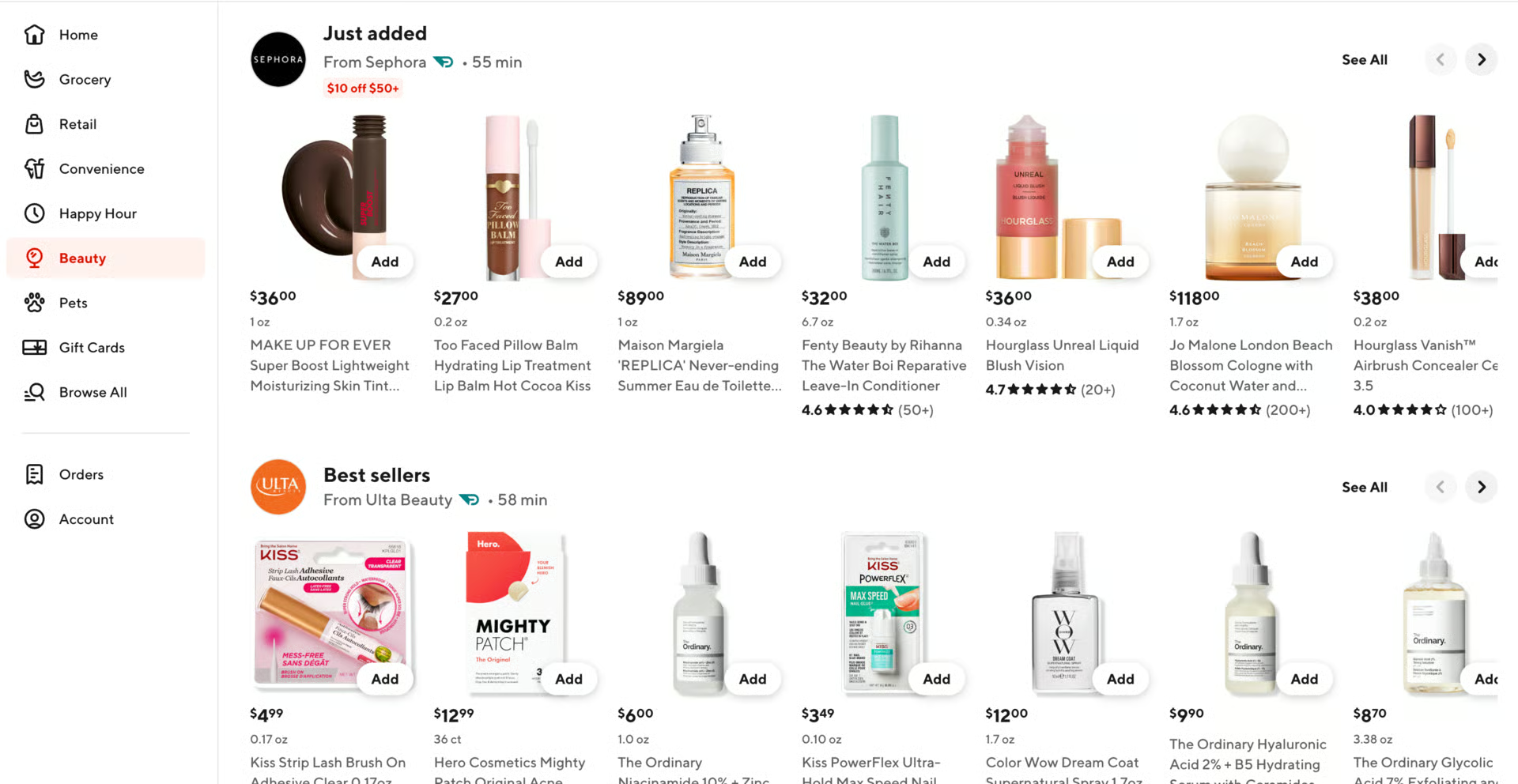
A sampling of products that you can now have DoorDashed
The problem with these last-mile delivery services, though, has always been that every incremental order requires a real person in the real world to go get it and bring it to you, so where’s the operating leverage to be had? It’s not like software that you can sell at almost no incremental cost, allowing profit margins to scale dramatically for every new dollar of revenue.
Instead, DoorDash is a software application, yes, but the economics of its business are structurally anchored to the physical world, which comes with lower margins than tech giants like Microsoft, Meta, and Alphabet.
Sound familiar? We discussed the same dynamics in our coverage of Uber earlier this year.
Two things opened my eyes to why this setup with platform logistics marketplaces can still make for an attractive investment.
Firstly, DoorDash has achieved sufficient order density and routing analytics to significantly improve its delivery unit economics through more efficient route projections and increased order batching (allowing one driver to deliver multiple orders at a time when there are enough customers in a given area, for example), making the overall business profitable, which is something that effectively all of its competitors, besides Uber, have failed to achieve.
Secondly, the business has layered on new forms of monetization that further improve the quality of these earnings. Paid subscriptions through DashPass are generating recurring subscription revenues and driving customer loyalty, and a $1 billion+ advertising business is quickly lifting margins for DoorDash.
Thus, DoorDash has turned from being almost one of the worst businesses you could imagine, losing money on every single delivery, to suddenly being profitable with seemingly tons of runway to double, triple, or even quadruple their top-line in the years to come, while raising operating profit margins from levels on par with a struggling airline today to something that may eventually better resemble the tech juggernaut it is.
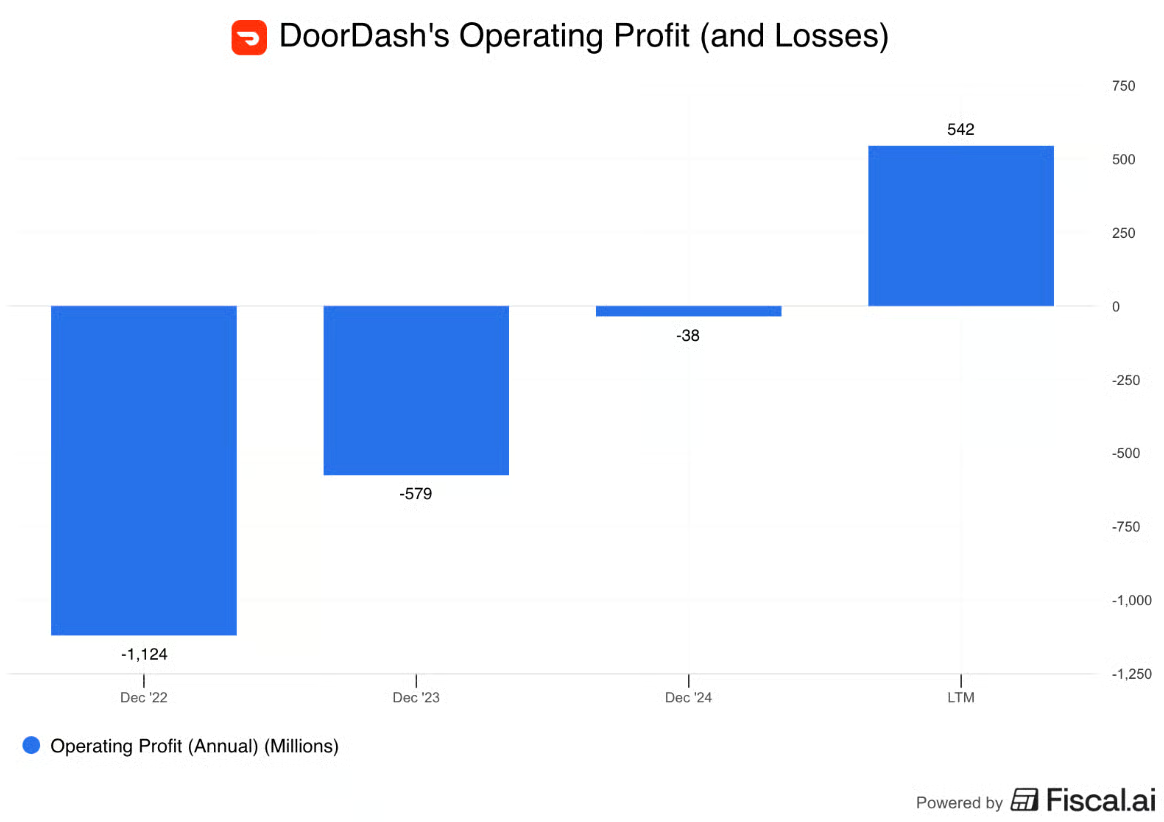
How’s that in setting the stage for today’s bull case? Obviously, it’s not all sunshine and rainbows with DoorDash, but the future does look promising.
Still, to play the bear a bit, this is structurally a variable-cost business, meaning only so much operating leverage can be achieved. As in, if you’re ordering delivery, you’re quite literally hailing a “private taxi for your burrito,” as I joked to Daniel. No wonder, then, through that lens, a basic Chipotle burrito order in-store can cost about $10, while delivery services might charge you a markup of 70-100%! (see below).
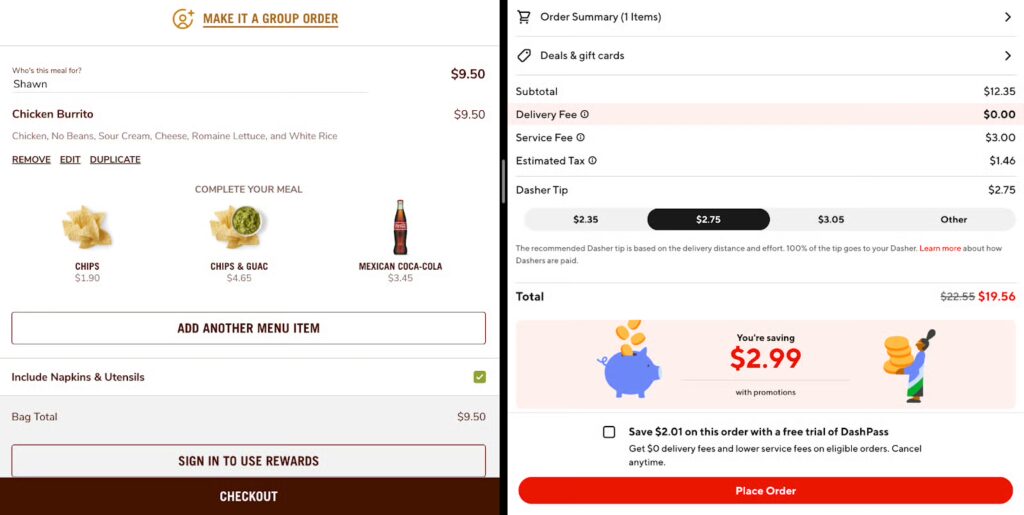
My order for pickup on the left, and the cost on DoorDash with a discount for the same order on the right
And yet…about 42 million people use DoorDash monthly. Even if Daniel and I can’t stomach the costs of weekly or even monthly delivery like this as value investors, plenty of folks certainly can, especially amongst younger generations.
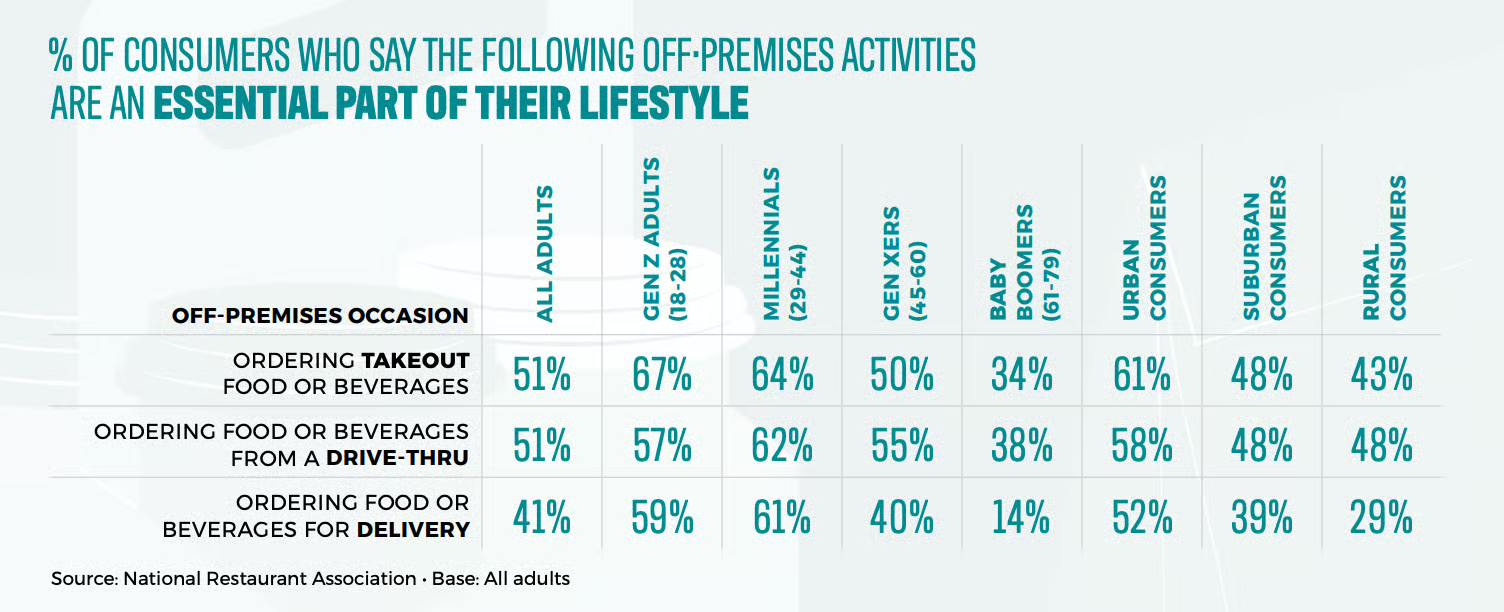
Shown below, 59% of Gen Z claim that ordering food/beverages for delivery is an essential part of their lifestyle (and 61% for Millennials!), versus 40% for Gen Xers and just 14% for Baby Boomers.
They’ve already facilitated more than $88 billion of gross order value (GOV) over the past year globally — roughly neck-and-neck with Uber Eats worldwide but with a larger market share in the U.S. — with the ambition of handling a much wider surface area of last-mile demand. If they execute on that, the economics look less like a meal-delivery app and more like something that could begin to rival Amazon(!)
What that means, in plain English, is that they’re leveraging their marketplace, logistics data, merchant relationships, and consumer popularity to deliver things like deodorant, toilet paper, or a bottle of wine from your favorite Italian restaurant in town, which are all well beyond the original business’s scope.
Sure, Amazon has done a lot of this already in the U.S., but DoorDash can fill some of its blind spots (like local wine delivery!) while doing so on a different time frame. Amazon can get you next-day or two-day delivery on things, but DoorDash can get you what you need in less than an hour.
To me, it’s sort of like comparing the consistency and affordability of a large retailer like Walmart or Costco with the premium we pay for immediate convenience at gas station convenience stores.
You might not do all your shopping on DoorDash (or at convenience stores), but when you need something quick, well, you’ll pay up for that, and DoorDash has taken that concept to another level.
Yet Another Silicon Valley Startup Story
Before we get too far ahead of ourselves, let’s understand how DoorDash came to be in the first place, so we can better understand its competitive positioning and the value it creates.
While this is ~yet another Silicon Valley story~, it’s closer to being a pull yourself up by your bootstraps tale of raw hustle than one about some wunderkind programmer building the next super app from their dorm room.
DoorDash began in 2013 as “Palo Alto Delivery,” a class project born out of walking door-to-door and listening to business owners discuss their biggest pain points, leading to a realization that many smaller merchants were declining delivery orders due to the cost of hiring delivery drivers.
The first version iteration of the service was as duct-taped together as any business I’ve ever seen. The founders literally ran deliveries themselves and used “Find My Friends” on their iPhones to see who was closest by to fulfill an order. It wasn’t pretty, but it did work around campus at Stanford and taught the company’s founders how to collect strategic insights from operating at the lowest level of detail.
That bottom-up hustle mentality has shown up again and again over the last 12 years, from CEO Tony Xu continuing to work the customer service desk daily, to the company’s most pivotal strategic choice in focusing on the suburbs.
On that latter point, everyone else (i.e., Grubhub, Uber Eats, Postmates) concentrated on city cores where customer density seemed like the obvious place to focus.
Yet, DoorDash found that suburban orders were larger (more families ordering), pickups and drop-offs were faster (easier parking, less congestion), and there was materially less competition, allowing them to sweep across suburbia, while its competitors fought it out for market share in a few major cities. Rather than blindly diving into what everyone else was doing, they followed the data and in-the-field insights to a more attractive opportunity.
Then the pandemic hit, creating an opportunity for each service to try and distinguish itself and emerge on the other side as THE dominant delivery service app nationwide.
On top of the tailwind of having masses of people locked at home looking for pandemic-safe ways to eat, DoorDash further capitalized on the situation via partnerships with national chains wielding heavy suburban footprints (think Chili’s, Chick-fil-A, and The Cheesecake Factory).
Incredibly, despite having a fraction of the financial backing, being a late-mover, and possessing no other businesses to subsidize its growth (like Uber was able to do with Uber Eats), DoorDash managed to rise in a few years from being basically a nobody to being by far the industry leader with 2/3 market share in the U.S. today:

DoorDash’s Rise out of Nowhere to Dominate the Industry
This was not without controversy, though. In 2019, a tipping scandal nearly destroyed the brand before the unbeknownst Covid tailwind could even emerge, with DoorDash essentially pocketing tips paid to dashers if a minimum compensation threshold for the order had already been met. Even two years later, dashers continued to protest their inability to see how much they’d be tipped on an order before accepting.
DoorDash has since changed these policies for the better, but whether you see this as business acumen or sleaziness is a matter of perspective.
Financially, that survive-at-all-costs mindset carried them through dicey fundraising terrain. They took a lofty valuation early, then in 2019 accepted term sheets from both SoFi and Sequoia, embracing extra dilution and governance tradeoffs in exchange for enough firepower to graduate from VC-fundraising permanently. Months later, COVID arrived just as DoorDash’s growth engine was beginning to hum at full speed, and the company IPO’d in December 2020.
In hindsight, the timing feels a bit lucky — a massive fundraising round provided ample resources to dump into marketing right before the biggest tailwind imaginable emerged (a pandemic keeping everyone stuck at home), yet the ol’ cliché that luck happens when hard work meets opportunity feels apt.
The Economics Of Your Delivery Order
For as expensive as the total cost of a DoorDash order can be, all of it is, of course, not going to DoorDash. Restaurants are getting the most, then dashers typically, then DoorDash, then there’s taxes, too.
When you order DoorDash via the “marketplace” (DASH’s main app), they earn revenue from a commission charged to merchants (typically 15–30% of the food order’s value) plus service and delivery fees paid explicitly by the customer.
There’s also a one-time ~$350 merchant activation fee to even get listed on the DoorDash marketplace, but let’s go through the standard economics of an example order: It’s a friday night, so you treat yourself to $22.40 of, say, spicy chorizo tacos, which might also include a $1.70 tax, a $3.30 tip, and a $5.50 service/delivery fee, totaling $32.90 for you to pay.
The restaurant gets paid for the cost of the food minus the 15-30% commission to DoorDash; the Dasher gets their payout (about $7.90 in this example), and DoorDash keeps the remainder, which ends up being around $4.90 on that ~$33 purchase.
That’s a lot of numbers, so fortunately, we have a tidy graphic prepared below to help:

That sample order, while presenting attractive unit economics for DoorDash, doesn’t capture the entire picture. That $4.90 must go toward covering the overhead costs behind DoorDash, such as the costs of managing their app, customer support, and the corporate team behind the scenes. There’s also payment processing, insurance costs, and data storage/compute costs, too. Granted, it’s just one order, but that $4.90 has a lot of heavy lifting to do!
Perhaps you can see now why scale is so important. With more orders, those overhead costs can be spread across a larger revenue base, and with enough scale, you can actually eke out an accounting profit. To be precise, it took more than $80b of gross order value for Dash to generate a GAAP profit for the first time last year(!)

That’s simple enough to understand, and as the business scales, spreading those revenues over a base of relatively fixed costs allows profit margins to scale from being deeply negative at the corporate level, to breakeven, to razor-thin profitability, to, hopefully for bulls, in the double-digit percentages.
Subscriptions, Advertising, and White Labeling
There are some other wrinkles to be aware of here, though. To drive more customer loyalty, which enables more efficient order batching and better profitability per order, DoorDash has its subscription program called DashPass, offering zero delivery fees (but you still have to tip!) with extra discounts and credits, as well as discounts on Lyft via a partnership program (a not so subtle attempt to try and mirror what Uber offers through Uber One memberships to ride-hailers and Uber Eats’ customers).
For users, a $9.99 monthly subscription is much more palatable, and cheaper, than paying delivery fees on every order. DoorDash, then, is effectively subsidizing its loyalty program, trading higher profits per order for more volume (plus some modest, recurring subscription revenues).
So far, the data has justified this approach, showing that DashPass customers do order more frequently than they did previously, but the churn isn’t insignificant. For the cohort that joined in March 2023, about 69% remained DashPass subs after one month, 36% after six months, and 28% after a year.
Remarkably, since 2020, average customer orders per year increased from 39 to 62 —roughly 10% compound growth, outpacing Uber’s ~3% and Grubhub’s ~1% growth rates in orders per customer. Again, more orders per customer means more opportunities to stack orders on the same route. When a Dasher can pick up two orders from the same plaza, the cost per order falls meaningfully.
But DoorDash isn’t totally forsaking margins for volumes. As DashPass subsidizes a greater number of orders, a growing advertising business helps to offset and actually expand DoorDash’s overall profitability. Essentially, merchants can bid for sponsored placement and search visibility (i.e., Chipotle paying to rank 1st when people type in “burritos nearby”), creating a high-margin layer on top of the gross order volumes they facilitate.
Ads have quickly become a needle-mover, hitting about a $1 billion annualized run-rate and becoming the primary driver of take-rate (or “net revenue margin”) expansion.
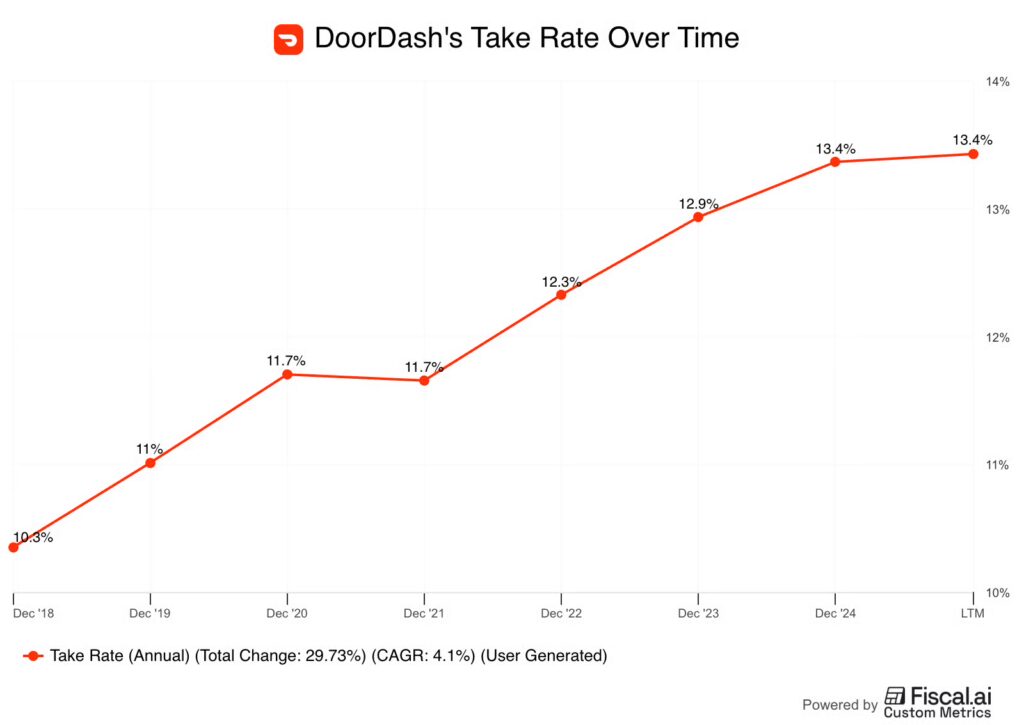
DoorDash’s revenue earned as a percentage of GOV has expanded over time, thanks to advertising
From 2018 to the last twelve months, Dash’s net revenue margin rose from about 10% to 13.4% — a 30%+ increase — primarily due to advertising. Because ads monetize attention, not just fulfillment, each extra dollar there carries higher incremental margins.

Illustration of DoorDash’s ads
Speaking of Chipotle, you might be surprised to learn that, yes, you can order Chipotle on the DoorDash app, but you can also order delivery directly through the Chipotle app as well, and guess who fulfills that? DoorDash.
And actually, the unit economics of this white-label business (referred to as “DoorDash Drive”) are a bit different.
For starters, under this model, restaurants oversee first-party ordering on their own website, while DoorDash manages the delivery logistics, allowing restaurants to preserve their brand and customer relationships while still tapping DoorDash’s Dasher network and software.
Because these customers are sourced directly through a restaurant’s website, a lower percentage fee is paid to DoorDash than on orders routed through the DoorDash app (marketplace).
Accordingly, this business is less profitable for DoorDash, but it facilitates a necessary win-win relationship, where restaurants pay higher customer acquisition fees for incrementally new customers directed to them by DoorDash, who may or may not have ever tried that restaurant without seeing it on DoorDash, while keeping more for themselves when the customer comes directly to the restaurant.
In other words, restaurants don’t want to pay DoorDash’s high marketplace fees for customers they’ve already acquired and who would dine with them anyways, such as those who might go straight to the Chipotle app, and DoorDash knows that, so they enable a balance that rewards themselves for the new traffic they can direct to a restaurant without being a parasite that totally leeches on restaurants, narrowing restaurants’ already-thin margins on existing customers.
If DoorDash weren’t to offer a white-label delivery service like this, they’d risk a race-to-the-bottom on delivery fees versus competition, with some restaurants opting out of 3rd-party delivery altogether. Or worse, restaurant failures if delivery orders accelerate while being incrementally unprofitable for these merchants.
In a way, you could say that DoorDash is acting as both Shopify and Amazon. Like Amazon, they provide a marketplace to order delivery to your door for 3rd-party goods, while also being like Shopify, which provides the tech infrastructure and logistics to empower merchants to make e-commerce sales on their own apps & websites, rather than going through Amazon to sell their product (and paying higher fees to do so).
Many brands actually take an omnichannel approach, using Shopify to sell through their own channels while listing on Amazon to reach a wider customer base, so it’s not an either-or.
Restaurants follow the same omnichannel approach — or at least, they can, thanks to DoorDash Drive and the main DoorDash marketplace.
Between a fast-growing subscription business, dramatically scaling order volumes, improved ad targeting, and DoorDash Drive restaurant partnerships, this is how you get a business that has compounded revenue by 50% per year over the last 5 years, with operating profit margins that have swung from -15% to ~5% in that same time.
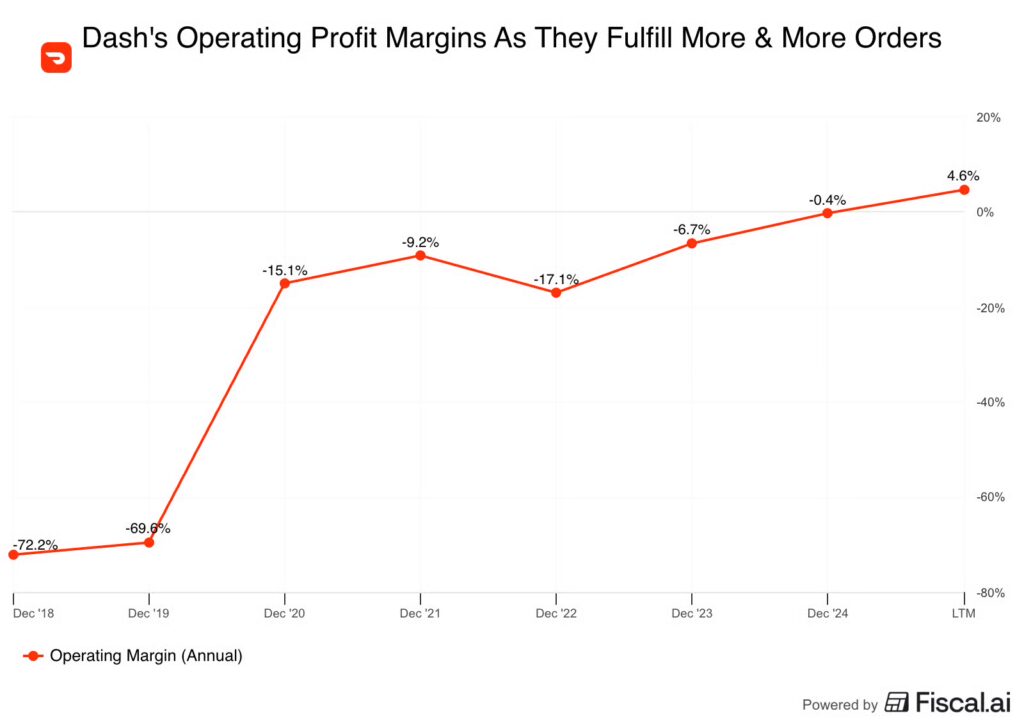
Inflecting profitability with scale
New Verticals
Oh yeah, this is all to say nothing of their expansion into new product verticals, as alluded to earlier. Non-restaurant orders (grocery, alcohol, essentials) add use cases for DoorDash’s services between mealtimes. By the end of last year, more than 25% of monthly active users had ordered from a non-restaurant merchant, up from ~20% a year earlier. That helps fill the gaps in food demand for dashers, which increases the probability of efficient batching at all hours of the day.
I should mention that DoorDash has experimented with ghost kitchens as well, where they provide the space for cooks to sell meals through DoorDash without needing to have their own physical restaurant space. They’ve also experimented with “Dash Marts,” which are like little warehouses/stores for popular items that DoorDash can place in central areas, making it easier and quicker for dashers to fulfill certain types of orders.
While interesting on the margin, neither moves the needle for the thesis, in my opinion, but the Dash Marts certainly resemble Amazon warehouses. Instead of catering to, well, whatever you can get on Amazon, these are more like things you’d need day of.
Global Scale Through Acquisition
Okay, before we get to valuation, let’s talk a bit about M&A.
There’s nothing fundamentally unique about the DoorDash business model that competitors can’t clone. So, as DoorDash focused on the U.S., overseas competitors copied its playbook (and others like Uber Eats), becoming the DoorDash of Mexico, Thailand, China, Australia, etc.
But before looking internationally, DoorDash first focused on the premium/luxury end of the customer spectrum. In 2019, for $410m, they bought Caviar, which, if you can’t tell, specializes in offering delivery for higher-end restaurants. The key insight is that the economics of delivery are much more attractive on bigger-ticket orders, yet Caviar couldn’t achieve the scale to work on its own; when integrated into DoorDash’s ecosystem, though, the combination is more promising.
Next, DoorDash turned its sights to Europe by acquiring the Finnish company Wolt in an $8.1 billion all-stock deal (pronounced “Volt”). Instead of stitching together a continent city by city, DoorDash used its financial strength to buy market share outright, capitalizing on the local popularity of competitors that couldn’t scale enough to be viable businesses on their own.
As Daniel has told me, in Germany, for example, there are three major delivery brands: Uber Eats, Lieferando (a local company), and Wolt, which he didn’t actually know was now owned by DoorDash.
Management has been so thrilled by the Wolt acquisition that they doubled down again, paying nearly $4 bilion for Deliveroo this year, further consolidating their market share in Europe (particularly the UK, Ireland, France, Italy, and Belgium) while also gaining exposure to places like Singapore, the UAE, Kuwait, and Qatar, adding a total of 7 million monthly active customers.
M&A is easy to model in spreadsheets but hard to execute. CEO and co-founder Tony Xu, who, I should mention, has $2.5 billion of ‘skin in the game’ in DoorDash, is openly skeptical of M&A given that, for most businesses, M&A deals have ended up destroying more value than they create
But for DoorDash, where scale is truly almost everything, M&A looks more promising. As mentioned, given Tony’s very substantial personal stake in DoorDash, he should be incentivized as much as anyone to think like an owner, indicating to me that he has legitimately seen something very promising in these acquisitions.
Last year, international revenue grew more than 50% versus roughly 20% in the U.S.

The synergies come mostly via shared playbooks, data, and greater combined financial firepower, not necessarily cross-border route density (local logistics don’t really enjoy global network effects — DoorDash expanding market share in Ireland has little to do with my customer experience in the U.S.). The strategic logic is in compressing the time required to achieve local scale, by buying the local winner, while layering over DoorDash’s ad network and membership programs in these smaller markets to improve the economics of their acquisition targets.
So, these acquisitions are less about sharing the benefits of scale with customers in their core markets and more about better monetizing smaller, fragmented markets.
The risk, though, is that DoorDash is paying up for thin-margin geographies and inheriting local headaches. That’s why I care less about how much gross order value they buy through M&A, and more about how quickly international subscription conversions, ad penetration, and order frequency catch up to U.S. cohorts.
Prefer to watch? Click here to watch this episode on YouTube.
DOORDASH’S VALUATION
So with all this, let’s do what we always do and try to determine the intrinsic value of this business. (As always, you can dive into our corresponding podcast about DoorDash for more on the business if you’re not ready for modeling.)
One of the first things I noticed as I tried to model the company’s earnings per share was the ludicrous rates of stock-based compensation they rely on, at around 9–10% of revenue.
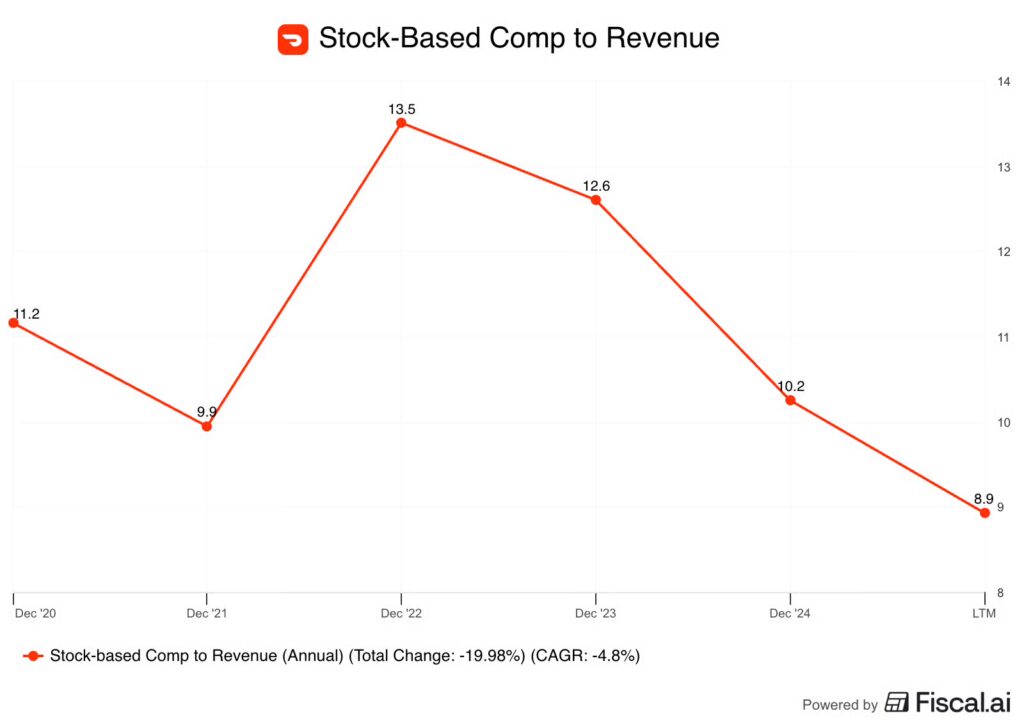
Meanwhile, there’s more than $2 billion of unrecognized stock-based comp set to hit over the next two years as RSUs vest. That’s a headwind to GAAP earnings and to per-share math, increasing the denominator in the earnings-per-share calculation and decreasing the earnings numerator.
While management authorized a $5 billion buyback to offset some of this, at the time Daniel and I recorded, repurchases were minimal year-to-date, and the fully diluted share count is up roughly one-third over five years(!)
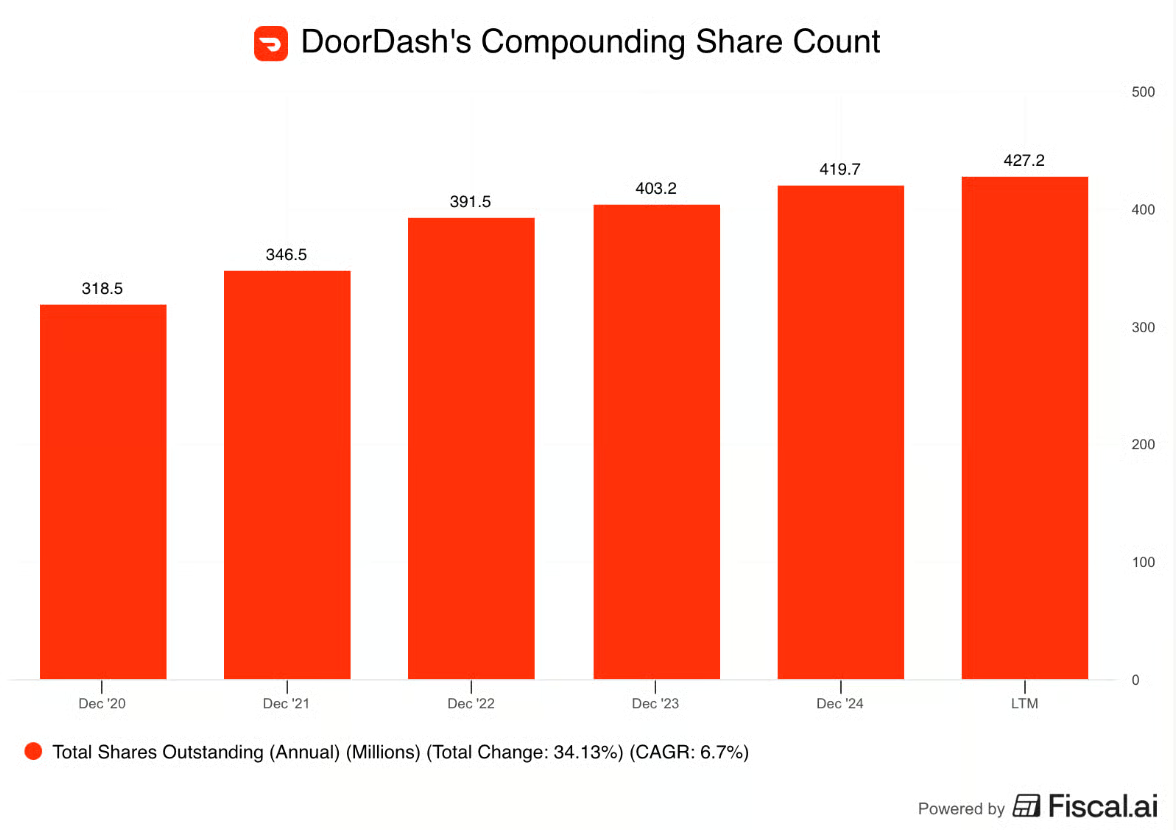
And while Tony Xu has real skin in the game, the broader management team receives more than 90% of long-term comp from RSUs, which I’ve jokingly (and not so jokingly) called “participation trophies,” where bonuses are paid over time simply for not leaving the company.
In case it’s not clear, the stock-based comp, management incentives, and lack of buybacks to at least offset share dilution are not inspiring.
Still, none of that may matter for DoorDash investors if the business grows as hoped. If they can go from facilitating nearly $90 billion in commerce as they are today, to, say, $300 billion over the next decade, capturing a larger but still very small fraction of global restaurant and grocery spending, then the company’s revenues (with a 13% net revenue take rate) would come out to about $39 billion versus less than $19 billion today.
With that more than doubling of revenue, I don’t think it would be unreasonable at all to think operating profit margins could swing upwards another 10 percentage points or so, as has happened as the business doubled in size since 2021. At which point, they’d be tripling operating profit margins in the coming years (5% today —> 15%).
I do actually think that’s plausible — the addressable market for local delivery is huge, and maybe even bigger than I think, but it’s really about timeline and competitive pressure. If they can reach that scale and profitability in 5 years, the stock is almost unequivocally undervalued. If it takes a decade, well, it’s a different story.
To illustrate, $39 billion in estimated profit with a 15% operating margin implies $6 billion in operating profit ($39 billion x 0.15). With a 35x EBIT multiple, the enterprise value is $210 billion (35 × $6 billion).
DoorDash, however, is worth about $100 billion today, so despite that huge inflection in growth and profitability, if you think DoorDash should be worth $210 billion by 2035, when you discount that to a present value over the next decade, then the expected rate of return is actually pretty average at about 8%…That’s a telltale sign that we’d be overpaying today; tons of aggressive growth assumptions are already priced in, such that, even in a very good scenario for the business, the stock returns would likely be average, at best, if nothing goes wrong.
This is all napkin math to say that, with what I think are plausible but still optimistic assumptions, the expected returns don’t look good for shares in DASH at current prices, barring growth that dramatically exceeds Wall Street’s expectations, without saying anything about how ongoing dilution would further chip away at expected returns.
While I do like the idea of betting on the convenience economy and have been genuinely impressed by the hustle and innovation that powered DoorDash to its oligopoly dominance over North American food delivery, Daniel and I will need a more reasonable price to consider an initial position.
I actually think shares looked attractive about a year ago, around the time we first started this podcast & newsletter. We’re not there yet, but we’re fast-approaching that level after a vicious selloff recently:

Anyways, here’s an excerpt from my DoorDash model, which you can click on to see the full thing. Portfolio updates, recommended reading, and inspiring quotes follow suit below.

(Disclaimer: The Intrinsic Value Portfolio is a portfolio of high-quality, long-term stocks built out weekly by our hosts, Shawn O’Malley and Daniel Mahnke. To track the portfolio, sign up here.)
About The Author
Shawn O’Malley: Shawn O’Malley is one of the hosts of The Intrinsic Value Podcast where they break down and values different business every week.
Shawn O’Malley
Shawn O’Malley is one of the hosts of The Intrinsic Value Podcast where they break down and values different business every week.
OUR COURSES