Skip to content
Pinduoduo (PDD) Intrinsic Value: Stock Valuation
By: Daniel Mahncke
It took us a while to pitch our first Chinese company. Probably too long. But today is the day. Pinduoduo (PDD) has made its way into many Superinvestor portfolios, including Li Lu – the investor who ran money for Charlie Munger and is known as the Chinese Warren Buffett – who has made PDD one of his largest positions.
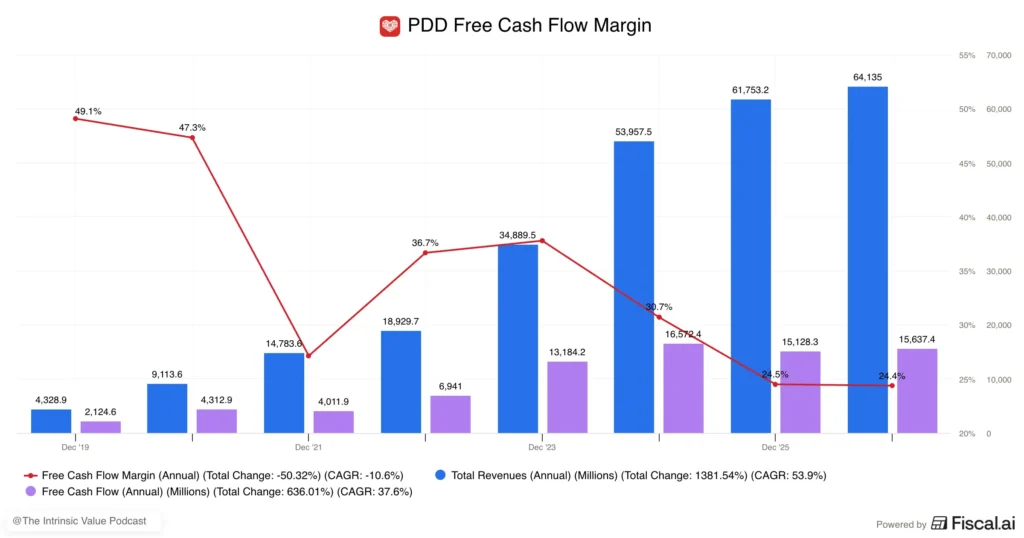
And it’s hard to overlook this company. Historical growth rates were astonishing, margins were fantastic, and, to add a margin of safety, PDD holds about 60% of its market cap in cash.
I say “were” because PDD is facing renewed uncertainty amid a business shift and a new investment cycle. Hence, the seemingly ridiculously low valuation. So is Mr. Market rightfully discounting PDD’s stock, or is this a phenomenal investment opportunity?
The answer to that, and more, looms below.
OVERVIEW OF PINDUODUO: IS PDD A BUY AT HISTORICAL LOW VALUATIONS?
A Latecomer in the Chinese E-Commerce Market
Pinduoduo (PDD) launched in 2015, which is absurdly late by Chinese e-commerce standards. Alibaba dates to 1999, and the other big competitor, JD, is even a year older than that. So just like Sea Limited, a company we covered a couple of weeks ago, PDD doesn’t fit the standard narrative that new entrants have essentially no chance at real success once one or two incumbents exist and reach logistics scale.
That thesis might still hold for Europe and the US, where most consumers are okay with paying up for quality and comfort, which means there is no wide gap beneath Amazon for someone cheaper to fill. In China and many emerging markets in the world, that’s different, though.
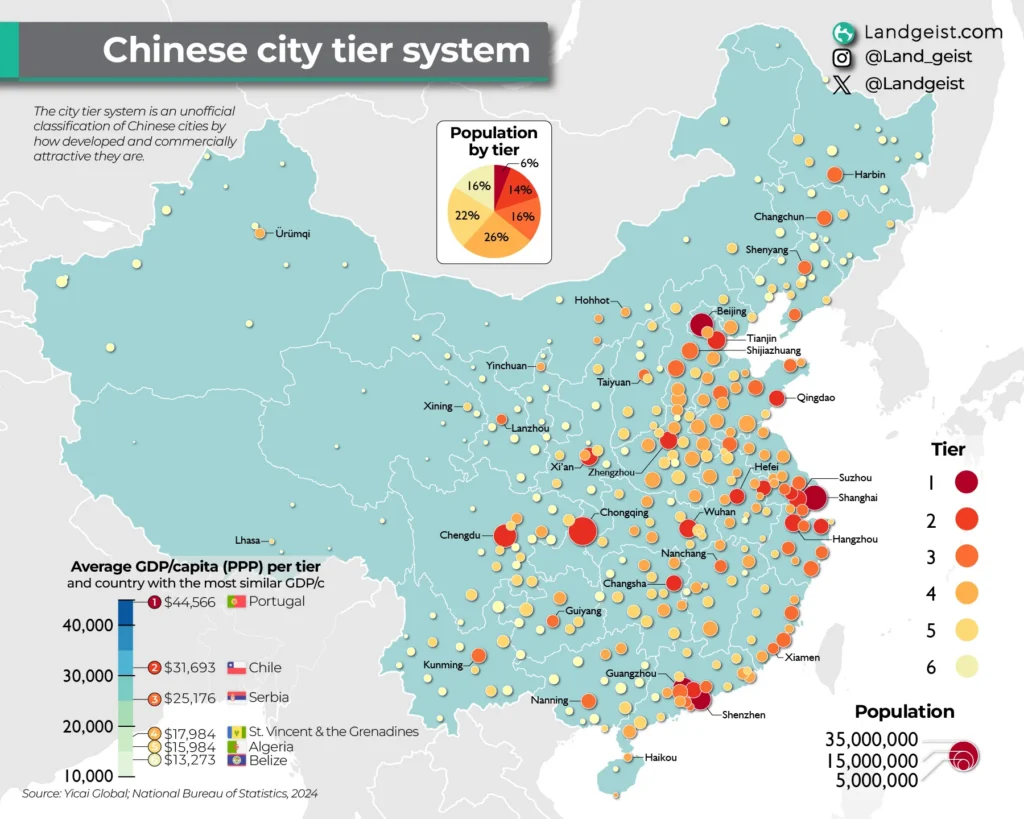
Colin Huang, PDD’s founder, saw a market that Alibaba and JD weren’t serving. They basically spent fifteen years building for Tier 1 and Tier 2 cities and largely ignored Tier 3 and below. And a “lower-tier city” in China in 2026 is not a village.
As I told Shawn on the show, I planned on visiting one of those Tier 3 cities with a friend of mine whose parents grew up there and still have a house there. He said it was one of the “smaller” cities. Turns out, it has about 12 million citizens. For context, so-called lower-tier Chinese cities reflect something like 70% of the population and well over half of GDP.
The other big tailwind was mobile adoption in the early 2010s. Cheap Android phones with Alipay and WeChat Pay built in flooded the lower-tier cities, so hundreds of millions of people who’d never shopped online suddenly could.
But Alibaba and JD’s marketplaces didn’t offer what most of them wanted. These new customers were intensely value-conscious, willing to put in the effort to save money, and they treated shopping as a way to pass time rather than a quick transaction – essentially a mall, just online.
This is where I’ll once again bore you with my e-commerce ladder framework. As a quick refresher, I tend to look at e-commerce companies through the lens of three different levels of development. Level 3 marketplaces cater to users with clear purchase intent who prioritize speed, quality, and service over price. Amazon, Coupang, and Meli are such marketplaces. They also tend to be vertically integrated and run massive logistics ecosystems, as well as payment and other value-adding operations.
Level 2 is the middle rung where the shopper has a general intent to browse but doesn’t yet know what exactly they want, and cares more about price than speed or quality. And then there’s level 1: more or less pure impulse, with no initial purchase intent when the app is opened, and discovery mostly through content. Think of TikTok Shop. Most people don’t go on TikTok to shop, but they stop on a video, like one of the products, click, and boom, you’ve bought a new shirt.
Part of why this is easy to do is because it’s so cheap! Price is arguably the most important factor.
In the beginning, PDD was unambiguously Level 1. It was defined by value-conscious buyers, gained traction through gaming and discounts, and had no ecosystem beyond the marketplace (i.e., payments or logistics). But that’s how Level 1 players can optimize for their target audience.

PDD reaches those buyers through a supply-chain model called C2M – consumer-to-manufacturer – built on top of something called team-buying. I’ll explain both properly in a moment. For now, the important part is that the model gave PDD a structural price advantage over Alibaba and JD, and it worked immediately. Just three years after its founding, in 2018, PDD went public on Nasdaq and surpassed Alibaba in annual active buyers.
Colin Huang, the Co-CEOs, and a Culture of Secrecy
The most difficult thing for me, looking at PDD, was how little insight we have into the business and numbers. PDD is probably the most secretive company I have ever looked at. PDD doesn’t give guidance; they didn’t have a CEO for years; they have a ~$75 billion cash pile (including short-term investments) that sits on the balance sheet unused; and when things go very well (as in 2024), there’s a good chance you’ll tune into an earnings call to hear them sounding off as quite bearish.
This culture was set by its founder, Colin Huang (or Huang Zheng). He was an early Google China engineer and had already built an electronics site and a gaming company before Pinduoduo. And in 2006, he had lunch with Warren Buffett, who was a huge inspiration for him. He was only 26 at the time and was brought by his mentor Duan Yongping – the man behind BBK Electronics and a legend in Chinese business.

Colin Huang with Warren Buffett
But in 2020, Huang stepped down as CEO of PDD. While precise details are not known, the timing lined up with China’s broader crackdown on tech founders. This was right around when Jack Ma vanished from public view. So this might have been a de-risking move to lower the company’s political profile and get the famous founder out of the crosshairs. He’s still by far the largest shareholder, though, owning north of 30% of the company, so I’m fairly confident the long-term vision is still his.
Day to day, the business now runs under two co-CEOs: Lei Chen, who runs Temu and the whole international, technical, and regulatory side that comes with it, and Jiazhen Zhao, who built Duoduo Grocery and runs the agriculture and supply-chain side of the company.
The Business Model – Three Segments and the Team-Buying Dynamic
While we lack many details, we should still dive into the business units and analyze what we have. On that note, roughly half of revenue is from the core China marketplace, a third is Temu (the international e-commerce arm), and the remaining ~15% is Duoduo Grocery.
The China marketplace was built on the C2M model I teased earlier. Team-buying lets you unlock a deeper discount by forming a temporary group to buy in bulk. That group can just be you and your friends or family, but you can also team up with a group of strangers via a link shared on WeChat or other socials, with a 24-hour window to fill the group.
Sellers on PDD’s marketplace usually list two prices for the same item – a higher one for individual shoppers and a lower one for the team buy. And the pitch to the manufacturer is that a bulk order gets a better price, with the savings flowing back to the group. The whole idea is to capture scale economics on the smallest possible scale. There’s also a network effect here that competitors don’t have. I don’t directly benefit when someone else buys anything on Amazon, but through team-buying, I very much do benefit on PDD when someone else buys something. So I want to tell friends and pull them into these groups.
The advantage for the factory is that it knows exactly how many units to make, so there’s no unsold inventory. And because the products are white-label, there’s no brand marketing, no distributor, no middlemen. And logistics aren’t PDD’s job either – the merchant ships straight to the buyer with a third-party courier.

Duoduo Grocery
The grocery business is the smallest of the three, so I won’t spend too much time on it, but it’s vital to PDD and was one of the earliest ventures. It runs on the same aggregation trick as team-buying, just applied to a neighborhood. Someone local becomes the “community leader” – often a local shop owner – and runs a group chat where members pool their orders. Those orders go to the merchant, and the next day everything is trucked to a single pickup point, usually the leader’s shop, where people collect.
The genius of it is that it’s pickup, not delivery. PDD’s customers don’t demand the luxury of home delivery. For a lower price, they’ll happily collect it themselves. And that matters, because fresh groceries are the hardest thing in all of e-commerce to make money on. Home delivery of a five-dollar bag of vegetables is a guaranteed money-loser, but pickup group-buying is one of the few models that actually solves it.
Temu – The International Arm
Temu was PDD’s attempt – a very successful one, at least at first – to take the factory model international. It launched in the US in 2022 and spread from there into the entire world: Europe, South America, South Africa, and so on. The same white-label factories that shipped to Chinese consumers now sell directly to consumers in the US or Europe. I still remember when it “hit” Germany. It came out of nowhere and was suddenly everywhere, mostly because you could buy an enormous amount of cheap clothing.

What enabled the model was the so-called de minimis exemption: any parcel below $800 could enter the US with no tariffs and basically no customs paperwork, on the grounds that it isn’t worth inspecting every cheap package. That was exactly Temu’s range, so effectively every order flew in duty-free. With that little trick and the backing of the PDD factory model, Temu quickly became the most-downloaded e-commerce app in the world, with over a billion users.
But you’ve probably already asked yourself: don’t we live in a new world following the tariff shocks of March 2025? And yes, we do – even though the original tariffs are no longer in place the way they were intended. The de minimis exemption for China-origin goods, and later for all goods globally, was eliminated around the time of the tariffs. Temu’s US GMV reportedly fell to under 30% of its start-of-2025 level, and daily active users roughly halved. To their credit, they moved fast, switching to a semi-managed, local-fulfillment model – recruiting sellers who already held US inventory and bulk-shipping stock in US warehouses. Users and GMV rebounded substantially.
But you could argue the rebound erased the thing that made Temu special: Holding or coordinating inventory in-country is a lower-margin, fundamentally different business. I’m not against physical e-commerce – I’m bullish on Meli and Amazon, which do exactly this – but for them it was the plan all along, whereas for Temu it’s a forced pivot, and anything that doesn’t lower prices runs counter to its value proposition. And Temu was (very likely) loss-making before, anyways.

Since those changes, Europe accounts for around 40% of Temu’s GMV, its biggest market, but the EU is moving forward with its own de minimis removal, with the Digital Services Act bearing down on product safety while the FTC is poking at it too. Despite all that, many estimates still expect an inflection to profitability, around 2028 to 2029. Watching this will be an important part of the thesis.
How the Economics Work – And why the Margins are so Good
China is the most competitive e-commerce market in the world, so it’s astonishing what margins PDD has put up. Part of the truth is that the government stepped in and told players to stop the subsidy war, so it took some intervention. But there’s another reason so many players coexist without destroying one another – the market’s scenario-based nature.
PDD, for example, optimizes for conversion, while Alibaba and JD.com optimize for the expected value of a purchase. Say JD figures there’s a 10% chance a customer buys a $1,000 iPhone if it’s recommended, versus a near-certain chance of a $5 pack of toilet paper. JD recommends the iPhone, because the expected value is higher. PDD does the opposite – it goes for the toilet paper. It prioritizes making the sale and building the habit of shopping on the platform. Especially when it comes to essential goods. You buy toilet paper every month, so that’s the conversion PDD wants – everyday goods, high frequency. And it’s working. Order frequency has gone from 15–20 times a year early on to more than 70 times today. Alibaba averages around 90, so there’s still room to grow.
Now, onto how PDD actually books revenue. It reports two lines – “online marketing services and others” and “transaction services” – split roughly 50/50. Online marketing services is the classic third-party-marketplace business: transaction fees plus merchant advertising, with most of the revenue and profit coming from advertising. The advertising take rate alone is estimated at around 4% to 4.5%. And I’ll keep saying “estimated,” because PDD gives us so little to work with.
The trend is what matters, though, and that one looks promising. In 2019, the advertising take rate was closer to 2.5%, so it’s roughly doubled, and I expect it to keep climbing.
For years, PDD acquired users so efficiently that the buyer side grew much faster than the merchant side. So you had a wall of demand chasing a thin set of merchants, and in that world, a merchant doesn’t need to advertise, because demand finds them anyway. But as the merchant base expanded, merchants started competing for the same users, bidding against each other for limited ad space. So the rising take rate isn’t PDD jacking up prices for ad space – it’s merchant-versus-merchant competition for a finite amount of attention. That’s the fairer, more durable way to monetize.
Competition – Trapped at Both Ends?
For the longest time, the Chinese fight was among the big three – Alibaba, JD, and PDD – who together control something like 70% of Chinese e-commerce GMV, with much of PDD’s gains coming straight out of the incumbents’ share.

But a new player emerged not long ago – Douyin, ByteDance’s short-form video commerce platform, known as TikTok to most of us. Douyin is the personalized danger every Level 1 player eventually faces. Barriers to entry are relatively low, and customer loyalty is thin, because competition is based almost entirely on price.
The big problem for PDD is who opens Douyin and why. Part of PDD’s appeal was the entertainment factor – the games, the discounts, and the constantly changing products. Now people open Douyin for entertainment, and Douyin is arguably the most powerful discovery-and-impulse engine ever built, extraordinarily good at putting something in front of you that you didn’t know you wanted and letting you buy it in two taps. I don’t use TikTok, but I see the same thing happening to me on Meta – just without a shop button attached.

Douyin’s e-commerce GMV reached around ¥4.3–4.5 trillion in 2025 (about $600 billion). And it’s still growing roughly 30% year over year at a scale where most platforms have long since slowed down. Douyin has also been pushing hard into “shelf” e-commerce – the search-and-browse storefront model rather than pure livestreaming – and that piece grew about 49% over the past year.
Nevertheless, it’s still much smaller than PDD, JD, or Alibaba on that front (60–70% of its GMV still comes from livestreaming). It will be interesting whether that changes and Douyin can make the move from “content-commerce” to “shelf-commerce.”
Prefer to watch? Click here to watch this episode on YouTube.
PINDUODUO’S VALUATION
PDD had a good week or two. When Shawn and I recorded the podcast episode, the stock was trading at $76. Now, it’s trading at $86. So the expected returns have changed slightly.
Nevertheless, it is still obviously cheap. The question is, how much trust can we put into PDD? Not only the numbers, but also their treatment of shareholders? As part of my valuation model, I added a discount to the cash position that is supposed to account for that uncertainty.
Without any discount, the cash alone would be worth about $50 per share. Even more when you also account for some of the other short-term assets. In the base case, I haircut it to $42 per ADS – close to 50% of the current stock price.
In my base case, I try to test what PDD is worth if the rapid expansion part of the story is over, but nothing actually breaks. So I assume growth slows materially across all three segments to a blended revenue growth of about 8%. I also have the margin settle at a lower level than it has in the past based on the most recent changes (19% in 2030 vs. mid-to-high-20s).
At a discount rate of 12%, a margin of safety discount of 20%, and an exit multiple of 12x, this leaves you with a fair value of $96 and an expected IRR of 16%. This is pretty solid considering the modest assumptions I made.
In a more optimistic scenario, which my bull case is for, you can easily get to a return double that and even higher. The main change is not in the revenue growth, but in the margin estimate. If we assume PDD will return to mid-20s margins, the stock could double or even triple from these levels. The market currently expects margins to decline “forever.” That’s where the opportunity lies.
The bear case is up for debate. If you give an even larger discount to the cash position here, arguing that it will never be returned to shareholders and instead be invested in a dying business model, then the stock’s bottom is far off. However, if we assume the cash would go back to shareholders at some point, which is not too unrealistic given that Colin Huang owns more than 30% of the company, the downside is limited. Even with a mere business outlook and counting only $40 cash per share, the fair value would be in the $50s to $60s.

Long story short, this comes down to trust. Trust in the management to do what’s best for the business, trust in the fact that PDD is politically “allowed” to do what’s best for the business, and trust in being seen as an actual partner as a shareholder.
You can really only make this decision based on your gut feeling. I had a good gut feeling about investing in Alibaba in 2022. They have proven through massive buybacks and communication that I, as a shareholder, will be able to take part in the business’s success as long as nothing (wildly) out of the ordinary happens.
But the world has changed since 2022. In my opinion, the geopolitical risks have further increased. Despite that, PDD’s secrecy makes me uneasy, and I don’t like their market position much either.
Honestly, I think I would be more inclined to look at the KWEB ETF overall. My Alibaba investment from 2022 performed very well. However, an investment in PDD at the same time would’ve performed even better.
I guess I simply don’t know who will be the biggest winner, but the generally muted valuations in Chinese tech could be a good opportunity to bet on. Although the geopolitical risks remain mostly unchanged by that.
To listen to our discussion of PDD, or for more company Deep Dives, check out our podcast here.
(Disclaimer: The Intrinsic Value Portfolio is a portfolio of high-quality, long-term stocks built out weekly by our hosts, Shawn O’Malley, Daniel Mahncke, and Kyle Grieve. To track the portfolio, sign up here.)
About The Author
Daniel Mahncke: Daniel Mahncke is one of the hosts of The Intrinsic Value Podcast where they break down and values different business every week.
Daniel Mahncke
Daniel Mahncke is one of the hosts of The Intrinsic Value Podcast where they break down and values different business every week.
OUR COURSES