Skip to content
Sea Limited (SEA) Intrinsic Value: Stock Valuation
By: Daniel Mahncke
By now, it shouldn’t come as a surprise when we cover an e-commerce player. We’ve covered a handful of them, and two of them, Amazon and Mercado Libre, have made it into our portfolio.
Most of them have one thing in common: they dominate one country or continent. Amazon owns the U.S., Mercado Libre owns Latin America, and Coupang owns South Korea. Each of those companies came up very differently but fought through some version of the same playbook, including heavy upfront investment, brutal unit economics, and a slow grind to profitability.
And in every case, we walked away from our research convinced that a dominant marketplace, once it gets to scale in its home region, is one of the most durable business models in modern capitalism. Not because e-commerce is the best business model out there, but because the ecosystems around it are among the most powerful out there.
Sea Limited is interesting in many ways. It’s one of the few players that has achieved massive success in an entirely different geography, and it uses a mobile game to subsidize its e-commerce and fintech operations. Yes, a mobile game…
Let’s dive in!
OVERVIEW OF SEA LIMITED
The Beginnings — From Steve Jobs to Sea Limited
Sea’s founder and CEO, Forrest Li, is Chinese by birth but did his MBA at Stanford. In 2005, while he was still a student there, he attended a graduation ceremony at which none other than Steve Jobs delivered what would become one of the most-watched commencement speeches of all time.
He gave a talk about how you can’t connect the dots of your life looking forward; you can only connect them looking backward. That was his way of telling students to be fearless and trust that a vision and hard work will get them where they want to be.

Li apparently took the message seriously, because the path that followed reads as a deliberate exercise in connecting the dots Jobs talked about. It was such an influence on Li that “connecting the dots” is even in the Sea Limited logo.
After Stanford, Li moved to Singapore and joined a tiny video game company called GG Game. It wasn’t a long tenure, though, as the company went bankrupt during the financial crisis. A year later, he and two friends co-founded Garena. The company that would, after several pivots and a rebrand, become Sea Limited.
The first games Garena published went nowhere. But then, in 2010, the company secured the exclusive Southeast Asian publishing rights for a brand-new title called League of Legends. The game was unknown at the time, which is the only reason a small Singaporean startup could win those rights at all. League of Legends turned out to be one of the most successful games of the past two decades. It made Garena profitable almost overnight. Tencent, the Chinese gaming giant, noticed and started investing in Garena, and eventually handed it the publishing rights to other major titles, including Call of Duty: Mobile.

So far, this looks like the success story of a gaming company, but not like the origin story of a commerce giant. That changed in 2017. Instead of leaving Garena to start something new, Li rebranded the entire company as Sea Limited (the “Sea” stands for Southeast Asia) and used it as the launching pad for two completely different businesses: Shopee, an e-commerce marketplace, and what was then called AirPay — a digital wallet that has since been renamed several times and is now called Monee.
Shawn rightfully pointed out that AirPay should’ve been Apple’s name for Apple Pay. Probably a missed opportunity for SEA to sell the naming rights to Apple. Anyway, Sea now had three businesses under its umbrella, all funded by a gaming arm that was about to deliver its biggest hit yet.
Garena — The Cash Machine that Built Everything
That hit game was Free Fire, a mobile-first battle royale. Fortnite and PUBG were dominating the genre at the time, but they were built for PCs or premium smartphones. Free Fire, on the other hand, was built for cheap mobile phones that make up the vast majority of phones in Southeast Asia and other emerging markets.

It always baffles me to realize we still live in such a big bubble in the West. From 2019 to 2021, Free Fire was the most-downloaded mobile game in the world. At its peak, it had over 150 million daily active users, and its esports events drew 5.5 million concurrent viewers. And yet, I hadn’t heard of it before, and when I asked friends, it seems I’m not the only one.
But in markets like Asia, India, Brazil, and even parts of Africa, this game was a huge hit. At its peak, Free Fire generated $4.3 billion in revenue. And while those numbers were not reached again, the game is still generating a stable $2+ billion in revenue annually, and revenue recently reaccelerated. Margins sit in the high 40s to low 50s, making Garena by far the highest-margin segment at Sea Limited and the only one that has been consistently profitable over the past decade.
If you stack Garena’s cumulative profits against Shopee’s cumulative losses over the same period, they more or less cancel out. So when Shopee was bleeding cash to take share in Brazil, a war it was openly fighting with Mercado Libre, the funding came from teenagers in Jakarta and São Paulo buying skins in a mobile game. That is a sentence I never expected to write about a publicly traded company!
By the way, if you want to create charts like the one below and get the most up-to-date financial data for over 100,000 companies, you should check out Fiscal.ai. We’ve been using Fiscal.ai since the start of our show and newsletter, and we have just recently partnered with them. So by using this link, you can save 15% on the subscription. It’s honestly the best tool we’ve ever used. Otherwise, we wouldn’t recommend it.

Honestly, as I told Shawn in our episode, if you had described this business model to me five years ago, the idea of funding an entire e-commerce platform and an emerging-markets fintech through a single mobile game designed to run on the cheapest possible hardware, I would have given it a 90% chance of failure (if not higher). Fortunately, as a value investor, I’m not getting paid to make predictions about speculative bets in other parts of the world. I’m taking the liberty to look at this business after they’ve won against all odds.
Shopee — Dominating SEA E-Commerce (+Brazil?)
The first number that pops out when you look at Shopee is its market share. Apparently, Shopee holds roughly 52% of regional e-commerce gross merchandise value (GMV) across Southeast Asia. I say “apparently” because this seems incredibly high for what is a relatively competitive market.
For comparison, Amazon has about 38% in U.S. e-commerce, and Mercado Libre has roughly the same in Brazil. So Shopee owns more of its home market than either Amazon or Meli does in theirs. And we are talking about a region of 700 million people that is far more fragmented than the U.S. and, to some extent, also more fragmented than Latin America.

The question is whether we can fully trust those numbers. There have been instances in the past where GMV was inflated for e-commerce players.
What stood out to me more than anything, looking at Shopee, is their operational excellence. And I gotta say, it’s hard to impress me on that end after looking at companies like Meli and Amazon. But Shopee simply had no business ever winning the SEA e-commerce market.
When Shopee launched in 2015, Lazada was already three years old, backed by Alibaba, and had essentially every advantage you could ask for: a superior technology stack, established seller relationships, cross-border sourcing from China, and effectively unlimited capital. By 2019, Shopee had overtaken Lazada to become the most-visited e-commerce platform in Southeast Asia. By the early 2020s, Lazada was in full retreat. Today, it holds a low single-digit market share.
If I had to break down Shopee’s success to one thing, I would go with adaptability. Lazada tried to copy Alibaba’s China playbook — a unified regional operation and a desktop focus that was adapted to mobile. Shopee was built mobile-first and has built a huge local operation in every country, acknowledging the differences between the regions and trends.
This has also been its secret to success in Brazil. When I researched Meli, I was blown away by how Shopee entered the market and became a strong competitor, while all the Chinese players saw more of a boom-and-bust than sustainable success. It took Shopee only 2-3 years to build a 90% local Brazilian merchant base. That’s incredible!
Competition — A New Threat
While Lazada seems to be out of the race, new competitors have been emerging. The first, and by far the most important, is TikTok Shop. In 2022, TikTok Shop was a small social shopping feature with negligible relevance. By 2023, its Southeast Asian GMV had nearly quadrupled to $16 billion. After acquiring Tokopedia, the combined entity held roughly 28% of regional platform GMV in 2024, second only to Shopee. In Thailand, TikTok Shop’s GMV more than tripled year-over-year in early 2025. In Vietnam, it grew 150% in the first half of 2025.

I recently talked to one of our Mastermind members at our event in Omaha. He is a hedge fund manager in Hong Kong, and we got lost in a conversation over e-commerce companies for hours. Happens to the best, as I like to say. Why do I bring this up? Well, in the U.S. and Europe, we think of e-commerce as a winner-takes-all market because we are used to Amazon dominating it. Beyond that, E-commerce players have historically not been very successful in expanding into other markets, especially when those markets aren’t similar to their home markets.

Shopee, on the other hand, showed in Brazil that expanding globally is certainly possible. Admittedly, it had a significant advantage thanks to Free Fire’s success in Brazil. That said, my conversation with that TIP Mastermind member, as well as my review of Shopee, made me realize how quickly the e-commerce landscape in a country can change. And now, TikTok Shop is proving that once again.
The thing that makes TikTok Shop different, and what gives me some confidence that Shopee can coexist with it, is that it isn’t really the same kind of marketplace. Shopee is search-driven, meaning users open the app to buy something. Perhaps they don’t yet know what they want to buy (which differentiates it from Mercado Libre or Amazon). TikTok Shop is discovery-driven, meaning users open the app to be entertained and end up buying things they didn’t even know they wanted 5 minutes ago.
I like to use these differences to categorize e-commerce companies into three different categories. Level 1 is TikTok Shop, where users have no purchase intent when they open the app. Level 2 is Shopee. There is a purchase intent, but it’s not yet known what one wants to buy. And then there’s Level 3, Amazon and Mercado Libre, where users have a clear purchase intent and know what they’re looking for.

The main differentiators here are what drives customers to the website and the quality and price of the products. The higher the quality and price, the less likely customers are to make impulse purchases. The upside, though, is that basket sizes are larger. TikTok Shop’s average order value in Southeast Asia is roughly $4.50 to $6.00; Shopee’s is $13 to $15.
Because of that difference, my working theory is that, so far, the growth has looked more additive than competitive. TikTok is expanding the overall e-commerce pie rather than carving up Shopee’s specific customer base. Of course, this could change, but if anything, there are signs that TikTok Shop’s growth is slowing.
TikTok Shop’s regional growth dropped from 70% year over year in early 2025 to 30% by late 2025, barely above Shopee’s own 25%. In Indonesia specifically, which accounts for 44% of the regional market, TikTok Shop’s market share versus Shopee has been essentially flat for a year.
Some bulls have pointed to TikTok’s logistics partner J&T’s 74% growth in parcel volume as evidence that TikTok is still expanding much faster than the headline numbers suggest. But when you decompose J&T’s growth — overall market growth, J&T’s own market-share gains as smaller logistics providers exited the market, and a new non-platform parcel business it launched — TikTok’s own order growth comes out closer to 40% on volume and roughly 30% on GMV. Still strong, but a long way from the runaway story it’s sometimes portrayed as.

Another sign that we won’t see a race to the bottom is pricing behavior. When Shopee raises commission rates, TikTok Shop typically follows within days. If TikTok Shop wanted to win market share at Shopee’s expense, it wouldn’t raise take rates; it would keep them stable or even lower them.
It’s also worth noting that TikTok Shop doesn’t have a payment operation, which is a huge ecosystem benefit for e-commerce players.
Monee — Sea Limited’s Mercado Pago
If you read or listened to our work on Mercado Libre, you’ll know how important Mercado Pago has become for Meli. In the beginning, it was built to enable Meli’s customers to make purchases online, as LATAM was still a very cash-heavy region. Over time, Meli doubled down on the fintech part of the business by enabling lending as well.
Sea’s story is similar. The original problem was that mobile game players in Southeast Asia had no way to make in-game purchases because credit card penetration was, and largely still is, extremely low. So Garena built AirPay, a network of physical counters at small businesses where users could deposit cash and convert it into a digital balance.

AirPay is now called Monee, and it has expanded into a full stack of consumer financial services: ShopeePay (the digital wallet), ShopeePayLater (buy now, pay later), Shopee Partner (merchant financing), and standalone cash loans.
Part of the reason I wanted to look at Shopee was due to its competition with Mercado Libre, so let’s compare Monee to Meli’s Mercado Pago and Credito to see how it holds up. The first dimension to check out is data quality.
The flywheel for both companies depends on using payment and shopping data to underwrite credit. Mercado Pago has a structural advantage here. Meli’s marketplace data has always been excellent for predicting creditworthiness, partly because Meli’s category mix tilts toward essential, higher-ticket purchases.
Shopee’s mix skews more toward fashion, beauty, and small impulse items, which are less correlated with financial reliability. The trade-off is that Shopee gets more purchase data points per customer because purchase frequency in those categories is much higher.
So Meli’s payment data is denser per transaction, but Shopee’s is more granular over time. Net-net, I’d still give Meli’s Pago the edge on predictive power.
The second dimension is off-platform reach. A fintech that only works inside its own marketplace has a hard ceiling. The real prize is getting users to pay outside the home ecosystem. That’s when the fintech becomes a standalone business rather than “only” being a feature of a marketplace. Mercado Pago is much further along here. Roughly half of its transaction volume now happens off Mercado Libre, primarily through physical credit cards that work anywhere Visa or Mastercard does.
Monee uses QR codes for off-platform payments instead of cards, which is a perfectly sensible choice in Southeast Asian markets where cash and terminals are far less entrenched, but it’s a slower path to ubiquity than a physical card, and Monee misses out on the interchange fees along the way. Today, only about 15% of Monee’s BNPL portfolio is off-platform, though that piece is growing 300% year over year. Malaysia, Monee’s most advanced market for off-platform, is at roughly 30%, which probably gives us a glimpse of where this is headed.
The third dimension, and arguably the most important one, is credit quality. Monee’s reported 90-day non-performing loan ratio is 1.1%. To put that in perspective, Mercado Pago is at 17%, and Nubank — the other emerging-markets digital lender Shawn and I follow closely — is at 7%. A 1.1% NPL ratio on emerging-markets consumer credit is, on its face, extraordinary. It would be a remarkable number for a domestic bank in a developed country, let alone an underwriter operating across Indonesia, Vietnam, and Brazil.

The problem is that I’m not sure how seriously to take it. Sea doesn’t disclose net charge-offs (the amount actually written off after recoveries), doesn’t give us a clear net interest margin, and only reports 90-day NPLs rather than the shorter timeframes most lenders disclose. Without those pieces, you can’t calculate the risk-adjusted spread, which is the single most important number in any lending business.
With Meli, we can see that a 17% NPL is more than offset by a net interest margin after losses of around 20%, so the risk is well-compensated. With Monee, you essentially have to take the 1.1% at face value and trust that the economics underneath work.
The risk is that if your denominator is full of brand-new loans that haven’t had time to go bad yet, and your numerator only reflects the smaller book from several months ago, you can sit at 1.1% NPLs all the way until you suddenly aren’t. I don’t know whether that would mean 3%, 4%, or even 10%, but it’s safe to say there’s risk in that uncertainty.
To be fair, the mix shift does explain why NPLs are generally much lower than for Meli. Monee’s loan book is dominated by short-duration BNPL with an average loan size of about $18 and tenures of three to six months. That’s a fundamentally lower-risk product than the cash loans and merchant credit that make up a larger share of Meli’s book. And Meli’s exposure to Argentina alone introduces a level of credit risk that no underwriting model can engineer away — chronic inflation, regular currency devaluations, and periodic debt crises will produce non-performing loans regardless of how sophisticated the algorithm is.
Where Monee might actually have the longer runway is the total addressable market.
Indonesia alone has 280 million people with single-digit credit card penetration as a share of the adult population. The Philippines, Vietnam, and Thailand look similar. The size of the under-banked population Monee can lend into in Southeast Asia is comparable to, and arguably larger than, what Mercado Pago had in front of it when it started scaling. If Monee executes well over the next decade, I wouldn’t be surprised to see it build the same kind of network and scale effects in Asia that Pago has in Latin America.
The Boom, the Crash, and the Comeback
I want to spend a moment on Sea’s stock chart, because if you’ve never looked at it, it tells you a lot about the kind of company you’re dealing with.
Sea went from around $40 at the start of 2020 to an all-time high of roughly $370 in late 2021. Almost a 10x in less than two years. Everything was going right at once: Shopee benefited from a pandemic e-commerce boom, Garena’s games exploded as people were stuck at home, and Monee rode the global wave of digital financial services adoption. Multiples compressed when the realization set in that none of those tailwinds were sustainable, and the stock began a brutal multi-year drawdown.

The pandemic reversal was only part of the story. In 2022, India banned Free Fire as part of a broader crackdown on apps with perceived Chinese ties (Tencent’s stake in Sea, still 17% today, didn’t help). That decision erased $16 billion from Sea’s market cap in a single day. And Garena’s quarterly active users collapsed from 730 million in 2021 to under 500 million by 2022.
Bookings were cut roughly in half. Meanwhile, Shopee had been burning cash on speculative expansion into France, Spain, Poland, and Mexico — none of which were working. And Tencent started selling about $3 billion of its Sea stake, which spooked investors about the possibility of further selling pressure.
So CEO Forrest Li pulled Shopee out of all the speculative markets. He concentrated capital on Southeast Asia, Taiwan, and Brazil. And the company cut costs aggressively. There are stories — possibly apocryphal, possibly not — about Sea switching to single-ply toilet paper in its offices to signal a culture of frugality. (That would have been a deal-breaker for me personally, I’ll admit.) Thousands of jobs were eliminated.
At least, the measures worked. Sea posted its first small annual profit in 2023. In 2024, net income jumped to $450 million. In 2025, it was $1.6 billion, more than triple the prior year. Revenue grew over 30% in the same period, with all three businesses positive on adjusted EBITDA.

And now the stock is down 50% again. The market is worried that the current investment cycle — expanding logistics, building fulfillment, launching VIP membership programs — is a defensive response to TikTok Shop, and that terminal margins might therefore be structurally capped closer to 1–2% of GMV rather than the 4–6% the bulls assume.
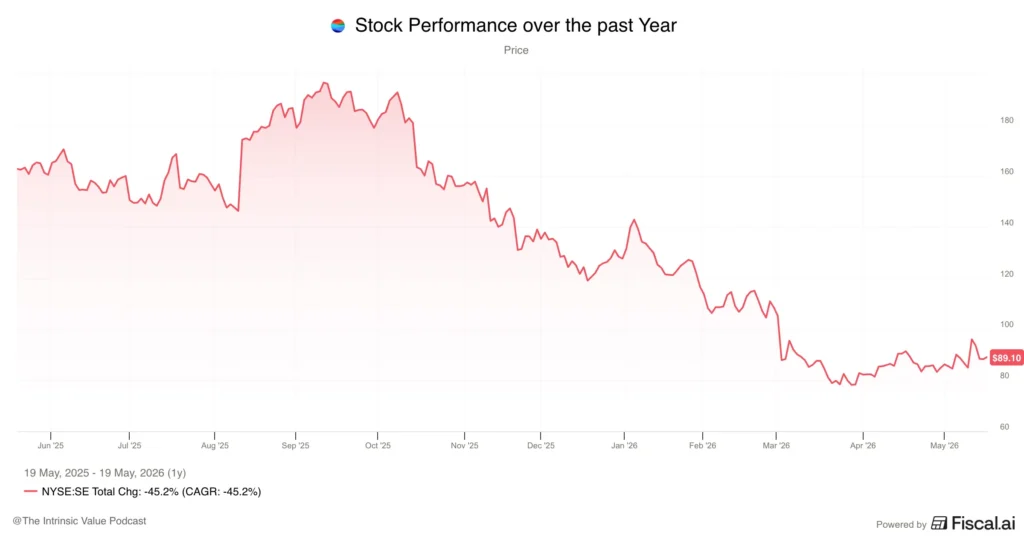
I don’t think the defensive interpretation tells the entire story. When Sea genuinely felt competitive pressure in 2022 and 2023, it cut prices and aggressively subsidized growth. Today it’s raising take rates and investing in infrastructure.
Those aren’t the actions of a company under siege. They’re the actions of a company that believes its competitive position is secure enough to invest in its capabilities because those investments will pay off in the future.
There’s also a pattern in Sea’s history of waiting and then acting decisively when competitors stumble. Before Monee scaled its lending book aggressively, it waited. It watched the Indonesian digital banks that had rushed into consumer credit start blowing up with non-performing loans. Only after competitors had stumbled and the data showed the field had thinned did Monee accelerate. The current investment cycle has more in common with that pattern than with a panic response.
There’s also a broader counter to the bear case worth mentioning: structural margins in e-commerce aren’t as compressed by competition as the TikTok argument implies. China is the most competitive e-commerce market in the world — Alibaba, JD, Pinduoduo, and ByteDance’s Douyin are all fighting hard, and yet all four earn roughly 2% EBITDA-to-GMV.

Estimates by Hayden Capital
That’s three times Shopee’s current 0.7%. The lesson from China could be that competition and profitability aren’t as tightly correlated as people assume. What matters more is whether all the players in a market eventually face the same economic pressure to earn a positive return.
There’s another argument, though. I, once again, invoke our Mastermind member who pointed out to me that Chinese e-commerce giants don’t earn that 2% GMV margin because of rational economic behavior, but because the government told them to stop the race to the bottom.
I guess we will have to wait and see how Southeast Asia and Latin America turn out.
Prefer to watch? Click here to watch this episode on YouTube.
SEA LIMITED VALUATION AND INVESTMENT DECISION
When we think about investing in Sea Limited, we have to consider the opportunity cost of putting that money to work in Mercado Libre or Nubank, our other emerging-market investments.
So let’s see whether the model suggests we should do that! Garena is running at roughly 49% EBIT margins today — a capital-light, high-margin business. Monee is at about 25% EBIT margins, and I’d assume modest expansion to roughly 28% as the loan book matures and Shopee’s purchase data compounds in the underwriting. One shouldn’t forget that a mix shift toward low-risk products tends to lower the margin. I still see a lot of potential for Monee to grow in the higher-margin products, though.
For Shopee, it’s all about the margins. Near-term, I’m modeling it at roughly 6% EBIT, expanding to about 12% by 2030, which translates to roughly 0.78% of GMV today, rising toward 1.56%. For context, Amazon achieves mid-single-digit margins as a percentage of GMV, and I’d expect Meli to reach 3–4%. Even competitors in the brutal Chinese market are earning in that ballpark (remember, though, this might only be because of government intervention). So my 2030 number is on the conservative end of plausible if Shopee executes.

Timing is the biggest swing variable. Sea may well keep investing for longer than expected, which would push the mature-margin year out beyond 2030. For the sake of modeling, though, I’m assuming the heaviest investment is behind us within five years.
All of this gives me a CAGR of 20% for revenues and an overall margin of 14-15%, with an exit multiple of 20x EV-to-net-profit (conservative for a company still growing at those rates), which produces a fair value of around $140 per share today. Applying a 20% margin of safety brings the intrinsic value to about $111. From the current $85, that implies a compound annual return of roughly 15% if the base case plays out.
I won’t go through the bear case since we are already running overtime, and I’ve thrown enough numbers at you, but you can check it out here.
All in all, Sea Limited, by my numbers, seems like the cheaper stock today compared to Mercado Libre. But I do feel like Meli is the better business with a stronger flywheel. You have better data for the credit underwriting, a more mature off-platform fintech operation, a more focused geographic strategy, and the most logistics-advantaged operation in its home market. And when I’m buying a company based on expectations for future growth, I’d rather pay up for a more mature business with clearer flywheel benefits and greater visibility into the payment operations.
So Sea Limited isn’t being added to the Intrinsic Value Portfolio, even though I think it’s a reasonable bet at these prices.
For more on Sea Limited, you can listen to our podcast here.
(Disclaimer: The Intrinsic Value Portfolio is a portfolio of high-quality, long-term stocks built out weekly by our hosts, Shawn O’Malley and Daniel Mahnke. To track the portfolio, sign up here.)
About The Author
Daniel Mahncke: Daniel Mahncke is one of the hosts of The Intrinsic Value Podcast where they break down and values different business every week.
Daniel Mahncke
Daniel Mahncke is one of the hosts of The Intrinsic Value Podcast where they break down and values different business every week.
OUR COURSES