Skip to content
The Complete 2026 Guide to Prop Firms for Beginners
Search for prop trading firms online, and a large volume of content appears, often focused on comparisons, rankings, or performance claims. Much of this material assumes prior knowledge and may not fully explain how these firms operate in practice.

This article takes a different approach. Instead of ranking providers, it explains how prop trading firms function, what rules typically apply, and what risks beginners should understand before participating. Pror firms are referenced in the article as examples to illustrate how different models work in practice. No firm makes it to our list unless it ticks all of the boxes below:
- No hidden conditions, clear documentation, consistent enforcement
- Simple evaluation steps, realistic targets, fair drawdown, and time flexibility
- Daily vs overall drawdown, scaling plans, and guardrails that teach discipline
- Education, community, coaching, and responsive customer service
- Rewards, leaderboards, and growth pathways beyond passing a challenge
- Platform stability, payout timeliness, and dispute resolution clarity
What Is a Prop Firm?
A proprietary firm provides traders with access to capital, typically through a structured evaluation process. Instead of depositing large personal funds, participants usually pay a fee to attempt a challenge designed to test trading performance.
If the trader meets predefined conditions, they may receive access to a funded account and earn a share of profits generated under the firm’s rules.
Most prop firms use either one-step or multi-step evaluation models. While details vary, common requirements include:
- Profit targets that must be reached within the evaluation
- Daily and overall drawdown limits that restrict losses
- Minimum trading days to ensure consistent activity
- Risk rules governing position size, strategy, or trading conditions
Failure to comply with these rules usually results in the account being reset or terminated.
Key Risks Beginners Should Consider
While prop trading reduces the need for personal capital, it introduces other forms of risk:
- High failure rates: Strict rules and performance targets mean many participants do not complete evaluation phases.
- Rule sensitivity: Accounts can be disqualified due to technical breaches, even if overall trading performance is positive.
- Accumulating costs: Evaluation fees are typically required, and repeated attempts may increase total spend.
- Psychological pressure: Trading under constraints – such as drawdown limits and performance targets – can affect decision-making.
Examples of Prop Firm Models
The following examples illustrate how different prop trading firms structure their programs, including models that may be easier for beginners to navigate.
One Funded
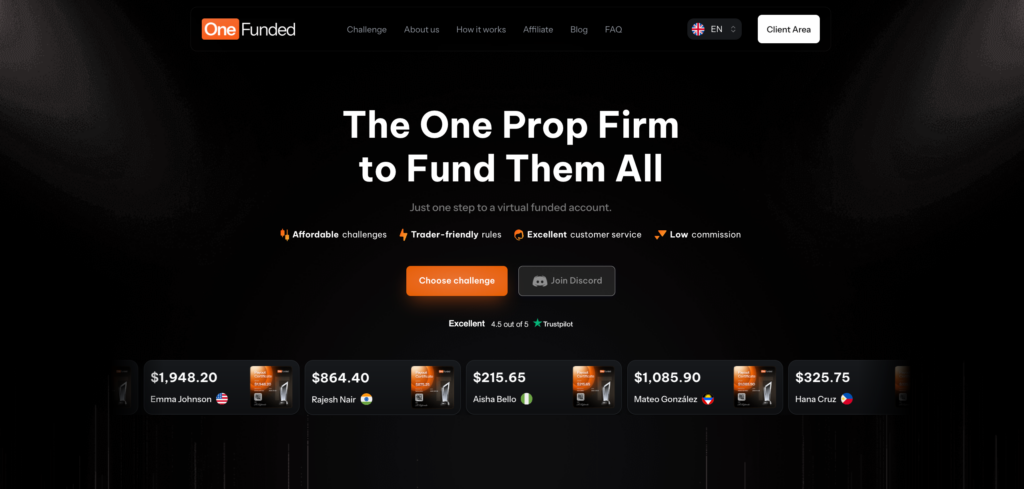
OneFunded is one of the fastest-growing prop firms providing simulated funded accounts up to $200,000 through evaluation challenges. They offer accessible entry prices (starting from $16), weekly or bi-weekly payouts, and support all major trading platforms used by prop traders, including MT5, TradeLocker, and cTrader.
The firm operates with full transparency: all rules, including risk limits and consistency requirements, are clearly published on the website. OneFunded provides public information about the team on the website. The business is also officially registered in the UK, with company details available on the website.
OneFunded positions itself as a trader-first prop firm. Support is handled by a real team, not just chatbots, and traders can communicate directly with staff and other traders in an active Discord community.
One of the things the founders – who are traders who remember the beginner experience – did was remove failure points that notoriously target beginners. These are time pressure, punitive restart costs, opaque rules, and many others that we will explore below:
No-deadline evaluation structure
OneFunded proclaims on its website that whoever wants to earn its funded account has forever to try. And the good part is that you get back the entry fees once you qualify for your first payout. This is a beginner-friendly feature that allows you to build confidence and earn a funded account without losing your sanity.
Transparent rule documentation
The standard practice in the prop trading space is that firms publish the trading rules and challenge structures on their website. The finer details can be buried in the terms and conditions but the key features like profit targets and drawdown limits are often on the home page. OneFunded adheres to this practice.
The firm provides clear, numerical rules for drawdowns and targets in its challenge tables. And the main part is that the content avoids vague terms like “reasonable trading.” Its FAQ and rules pages use plain language to explain concepts like trailing vs. static drawdown, which directly addresses common beginner confusion.
Rewards center program
Beyond profit splits, OneFunded offers a loyalty program under the Rewards Center banner. The program offers discounts and free challenges; specifically, traders earn points by completing tasks, which are tracked in real time on their dashboard. The traders can then redeem the points for rewards such as percentage discounts or free challenge accounts. This program teaches disciplined process over outcome. Plainly stated, a beginner can be rewarded for consistent, rule-compliant trading even before hitting a full profit target. And this reinforces positive habits without requiring immediate perfection.
Leaderboard functionality
OneFunded also has a leaderboard system and showcases the details in a self-scrolling carousel on the landing page. Here, the firm displays trader payouts across different countries, and highlights top performers with real earnings. If nothing else, this functionality is a source of motivation and community benchmarking for traders. A beginner seeing achievable success stories from peers is the push most need to keep working hard. It also reduces the isolation of solo trading and turns competition into a learning tool rather than a source of intimidation.
How Does OneFunded’s Challenge Pathways Look Like?
The first time you sign up for OneFunded’s trader funding program, you’ll need to choose a challenge.
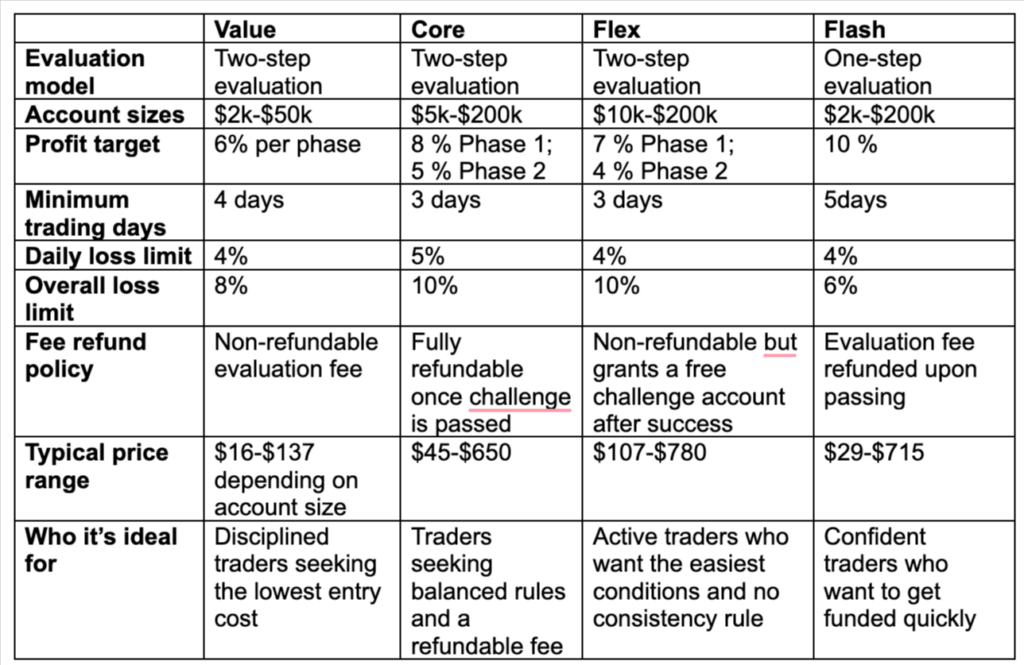
You can choose from the four tracks to get funded at OneFunded; they are Value, Core, Flex and Flash. The good thing is no matter what program you choose, the firm doesn’t require you to complete the challenge in a specified time period. And you get to choose the account size that you know you will manage and meet all goals. The table below summarizes the key details for each track:
What mistakes are fatal?
Some slipups may see you lose the challenge and require that you start afresh. These include:
- Exceeding maximum overall loss at any point
- Violating daily loss limit during trading hours
- Trading with proscribed strategies
- Failing to meet minimum trading days before requesting funded
However, some mistakes may only slow progress and do not lead to disqualification. They are:
- Taking fewer trades than optimal
- Missing profit targets within your first few weeks
- Withdrawing from markets during unfavorable conditions
- Starting with conservative position sizes below your account’s capacity
PipFarm
PipFarm started operating in 2023 and is the operational arm of Singapore-registered ECI Ventures Pte. Ltd. The firm states on its website that its focus is on remote traders who wish to pass evaluations and earn funded accounts. And those who succeed can scale their accounts up to $1.5 million.
Why is PipFarm Beginner-Friendly?
The prop firm is beginner-friendly options out there for several reasons. And the first one has to be the design of the onboarding process. Once you’ve paid for a particular challenge and started it, PipFarm awards one Experience Pip (XP). XPs are reward points that PipFarm’s traders earn whenever they complete a milestone. The milestones can be starting or passing a challenge, passing ID verification, or receiving payouts.
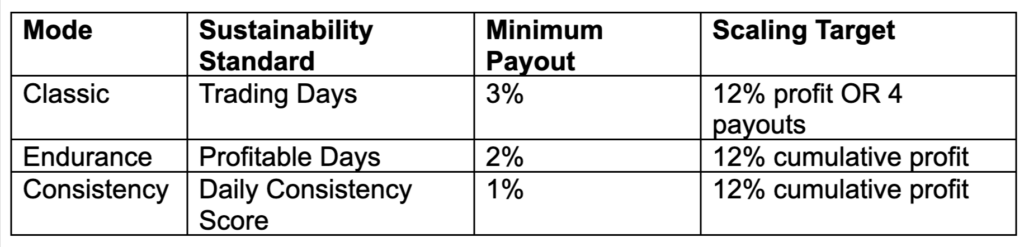
Secondly, PipFarm, like OneFunded, offers several challenge options, and each option has account sizes ranging from $5,000 to $100,000. Even better, each challenge mode has unique sustainability standards to favor as many types of traders as possible. For example, you only need to trade for the specified number of days and achieve a 3% minimum payout to succeed under the Classic evaluation mode.
Third, PipFarm has several beginner-friendly tools and protections. For starters, all traders are covered by the firm’s payout protection feature. The feature allows traders to receive a piece of profits even if they breach minor rules and are overall profitable. There is also the kill switch feature. This is an automated risk control mechanism that lets traders set hard limits on both losses and profits. Once these thresholds are hit, the system automatically closes all trades and locks the account for the rest of the trading day.
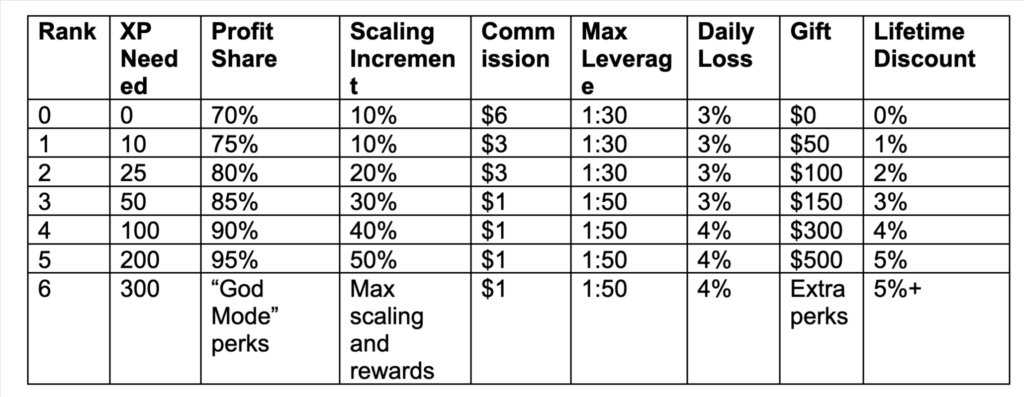
Although we’ve covered it partially, we should state that PipFarm’s reward system makes for a powerful beginner-friendly feature. Especially considering that it is progressive. It starts traders at Rank 0 and then graduates them progressively to Rank 6. Each rank unlocks power-ups that improve trading conditions and rewards. See the table below for details:
PipFarm Challenge Design
PipFarm offers three options when choosing a challenge; you can either opt for Classic, Endurance, or Consistency mode. What this means is that clients can customize their challenge, which affects how they perform. Each of these modes are available in both one stage and two stage formats.
The Classic Mode is the most simplified track. It has simple trading day requirements, which means clients only have to worry about profit targets without tracking additional metrics. For the Endurance Mode, the “profitable days” requirement demands that traders must close at least 0.5% above their opening balance on a minimum number of days. and the Consistency Mode is the most sophisticated. The track caps how much of your total profit can come from a single best day, which discourages the beginner mistake of relying on rare home-run trades instead of building repeatable edge. The table below shows more information about the modes:
Scaling to $1.5 Million at PipFarm
We saw earlier that PipFarm’s scaling system is tied to their XP ranking system. And that each scaling event increases your account balance by a predetermined percentage. However, only after you’ve demonstrated sustained profitability over multiple payout cycles without violating risk parameters can you progress to the next rank.
But how do beginners get to the ultimate prize of a $1.5 million funded account? First, you must be eligible to compete for this funding. You must:
- Hit 12% profit target, OR
- Achieve four consecutive successful payouts
Let’s say you have a $100,000 funded account in Classic Mode. The first stage of the road to the $1.5 million funded account starts with earning $12,000 profit. As a result, the account will scale by 20% to Rank 2; the new account size becomes $120,000.
You replicate the same success at stage 2: you earn 12% profit, that is $14,400 on $120k, and the account scales by 30% to Rank 3. The new account size becomes $156,000. You build momentum and hit four consecutive payouts, and the account earns a 40% increment to Rank 4. So, the new account size is now $218,400.
The higher ranks have even bigger increments, which is the fourth stage in the scaling journey. At Rank 5, you earn a 50% scaling increment, and the maximum possible reward at Rank 6, which is more than 50%. If successful at each cycle, you arrive at the final stage, where PipFarm grows your account to the $1.5 million cap.
Where PipFarm Falls Short for Beginners
PipFarm has a lot of things going on that can quickly confuse a newbie. For starters, the ranking system, commission tier progression, profitable days tracking, and consistency score calculations create a mental load that easily overwhelms learners. This gamification may work perfectly for veterans who have already mastered the basics.
Specifically, we found that the consistency score requirement is a huge pain point for beginners. For example, suppose you have a day where you capture a 4% gain on a strong trend-following trade. But under Consistency Mode rules, if the total evaluation profit sits at 8%, that single 4% day represents 50% of total gains. And this violates the maximum best-day contribution threshold. So, you may end up being disqualified for having a great trading day.
There is also the weekly payout cap of $5,000 unless consistency drops below 30%, which creates a perverse incentive that hurts beginners most. Typically, newly funded traders have volatile performance, which produces high consistency scores. But these scores trigger the payout cap. Simply put, a beginner who generates $8,000 in a strong week can only withdraw $5k, and the remainder is locked until subsequent weeks when performance might not repeat. But if you look at payout policies such as OneFunded’s, you’ll notice no such arbitrary caps, which create a predictable cash flow during the critical early months when financial pressure often forces premature position exits.
Trade The Pool
Unlike the two firms we’ve already covered, Trade The Pool (TTP) solely focuses on stocks and ETFs. TTP was founded in 2022 and is affiliated with The5ers, an established prop firm. The firm promotes the concept of limited risk trading, which is just another way of saying traders do not risk personal funds, the firm has structures in place to prevent traders from losing money, and that it measures success based on trading ability, not how much money you spend to be funded.
What Makes TTP Beginner Friendly?
The first and most important factor has to be TTP’s beginner-specific program paths; the website literally lets you choose “Beginner” vs “Advanced.” When signing up, the page will ask for your trading level and then offer four choices: Beginner, Advanced, Day Trade and Swing. In other words, TTP has designed the onboarding experience to route newer traders into a more appropriate ruleset instead of one one-size-fits-all challenge.
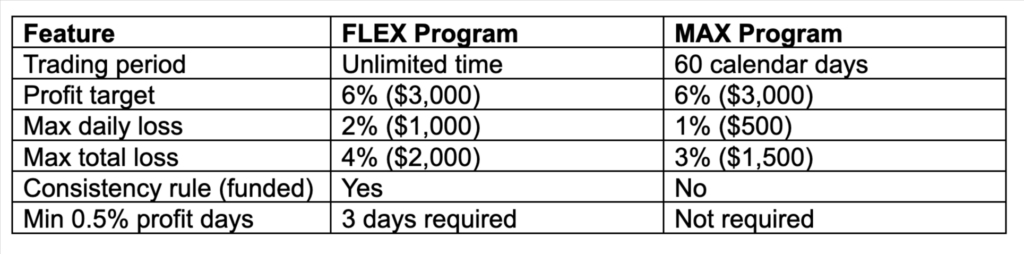
So, if you’re a beginner, the firm will place you in the FLEX program. The more experienced traders might want to choose the MAX option. Here is how the two compare:
The second factor that makes TTP beginner friendly is the focus on familiar assets, stocks. Of course, the working assumption here is that beginner traders are familiar with stock trading. They only begin to transition to sophisticated assets like forex and futures when they have grown some solid legs.
Third, TTP’s extended trading access matches how beginners actually learn stocks. this type of traders often need time to practice entries and exits around gaps, earnings reactions, and premarket or post market moves. Our investigations found that TTP allows overnight or off-market trading, after 4:00 pm ET through the next open. It also states on the website that it provides 24/5 trading (Monday 3:00 am ET through Friday post market).
Lastly, TTP has a feature it calls buying power, which it frames as beginner-friendly. The feature works more like leverage and it represents the maximum dollar amount of stock positions you can control in your funded account, regardless of the actual account balance. In other words, it allows you to trade “big-name” stocks and ETFs without needing large personal capital.
Beginner Pain Points with TTP
Our research established that just like PipFarm, TTP falls short in some areas from the perspective of newbies. We have highlighted the biggest pain points below:
- Our search through Trustpilot and Reddit found several beginners reporting initial frustration with trading rules. They noted that the rules are clearly stated but can be difficult to internalize.
- TTP does recognize as valid any trade closed with a profit of less than 10 cents. This means beginners can take a 5-cent losing trade that counts fully against drawdown, but a 9-cent winning trade gets invalidated and doesn’t count toward profit targets.
- Some traders on Trustpilot complained about constant problems with holding positions overnight and orders disappearing without explanation. This issue is particularly problematic for beginners attempting TTP’s 24/5 trading feature and lack experience distinguishing between normal execution delays and platform malfunction.
- Lower profit splits reduce beginner take-home earnings. TTP’s FLEX program, which targets beginners, offers a 70% profit split while competitors like OneFunded offer 80% default splits, which can rise to 90%.
For Traders
For Traders was founded in 2023 and specializes in forex, crypto, and futures markets. The firm is headquartered in the Czech Republic and was previously known as Billions Club. According to their website, the firm is the brainchild of experienced tech entrepreneurs and traders, and it operates globally. Besides rosy numbers like serving over 60,000 customers across 130+ countries, and having paid out more than $7 million to traders, For Traders is a great choice for beginners.
Why For Traders is a Great Choice for Beginners
For starters, For Traders prominently proclaims on its website that it is the prop firm for beginners. We found the following features to support the claim:
Unlimited evaluation time
Once you sign up for any of For Traders’ challenge tracks, you have forever to try and meet the goals. Obviously, we wouldn’t advise you to take that long but the gist is that you are not racing against the clock to complete the challenge. Ask any trader and they will tell what a huge confidence booster this feature is.
Beginner-friendly challenge structure
You can become a For Traders funded trader the traditional way, through evaluation, via three tracks or instantly via two tracks. The evaluation tracks are One-Step, Two-Step, and Three-Step, and the instant track includes Instant Master and Instant Master PRO. This level of options gives beginners plenty of entry points, which they can select depending on how confident they feel. And each track has account sizes from as low as $6,000 to $100,000 for forex, up to $50,000 for crypto, and from $25,000 to $100,000 for futures.
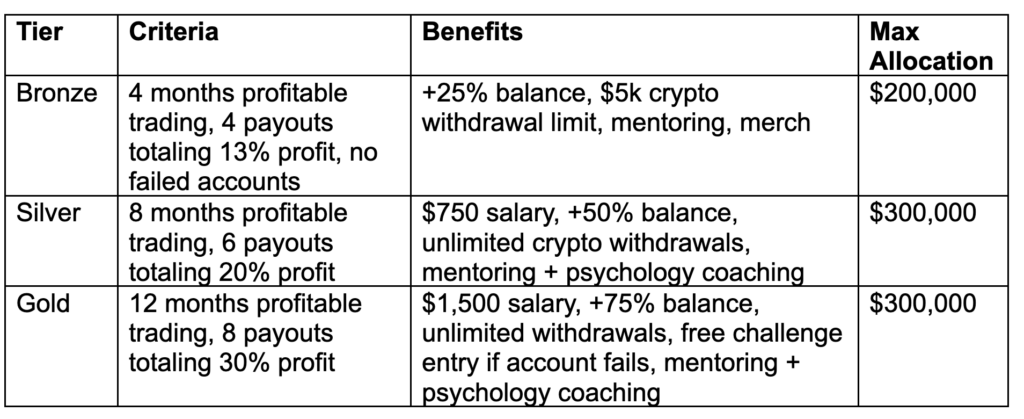
And the firm assesses that you are a great performer, they will let you apply to be a premium trader. The premium trader program targets clients who have shown long-term consistency, discipline, and profitability in For Traders’ simulated environment. It’s essentially an elite tier that rewards professionalism and sustained performance. And it has three tiers, as shown below:
AI Coach feature
For Traders leverages artificial intelligence to provide personalized, real-time trading guidance, which is a feature many beginners desperately need. The coach reviews your trading performance and gives you tailored tips.
Plenty of free educational material
For Traders has an Academy that packs a lot of educational content. This includes video courses and eBooks. There are also regular events and a blog section that is updated frequently. And if you prefer Discord, the firm’s channel has over 20,000 members, and our probing found that at any given time, you will find no less than 1,500 participants online.
48-hour payout guarantee with penalty clause
For Traders tells every new member that they will honor withdrawal requests in under two days. And if the window passes and your payout hasn’t arrived, they will owe you a penalty. This guarantee is encouraging to beginners who need assurance that their effort will bear something.
Where For Traders Falls Short
From the onset, our investigation on forums like Reddit and Trustpilot found that For Traders has a problem which we will call rule-set fragmentation. This is to say that the firm’s constraints change materially by product. For example, the 40% margin rule applies to many forex challenges and their Master Accounts, but does not apply to Instant Master or Instant Master PRO and some markets like crypto. As such, a newbie may not realize they’re choosing not just an account size, but an entirely different compliance framework.
Secondly, we found that the firm’s 40% margin rule is unusually easy to violate by accident, especially if you stack positions. Their definition is plain: it covers one trade or multiple trades on the same instrument in the same direction. So, common beginner behavior like adding to a winner, stacking entries, or reopening after partial closes can trip the rule even if each individual trade looks small.
And, the minimum profitable day definition can surprise beginners. On the For Traders site, the firm states that for a trading day to count, it must show at least 0.5% profit; this is in the context of minimum profitable days. This is an unfortunately specific threshold that can push beginners toward forcing trades to make the day count.
Blueberry Funded
Blueberry Funded is the first broker backed prop firm in this list. But that is not the firm’s only selling point when it comes to beginners. The following features make it an option that newbies can consider when looking for a funded trader partner:
Zero Pressure from Time Limits
Blueberry Funded displays three things prominently on its website: funding of up to $2 million, instant funding, and no time limit. The latter should excite any new trader looking for a prop firm.
Almost all of Blueberry’s challenges, except the 7-day “Rapid” option, have unlimited time to complete. And that means you have the chance to work your way around the evaluation without making rushed and poor decisions. So, you end up learning proper risk management and recover from losses calmly. Nothing boosts a learner’s confidence better than this.
A Challenge for Every Level
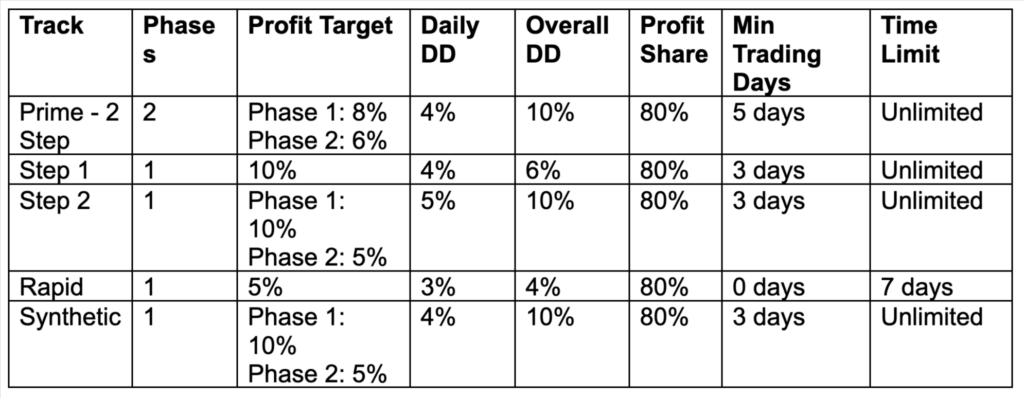
There are seven tracks to choose from and two provide instant funding. Of the five evaluation tracks, Blueberry identifies the Prime-2 Step as the most popular, and it is easy to see why. It offers account sizes between $5,000 and $100,000, and you have two phases to get through. That also means you face less strict drawdown limits than the other evaluation tracks. The table below shows how this challenge compares to the other four evaluation tracks:
The idea here is that you’re not forced into a one-size-fits-all model. This is the same freedom of choice you get with firms like OneFunded.
The Option to Copy Trade
One of the most important questions that beginner traders often ask is whether they are allowed to copy trade. Blueberry answers ‘yes’ to that question, although the option is not open to all programs. And the caveat is that you can only copy trade between the accounts you own regardless of the trading platform they are on. In other words, you can spend time to design a robust strategy for one account and then mirror the setup across all your accounts wherever they may be.
Where Blueberry Funded Underdelivers for Beginners
No news trading policy
Blueberry allows news trading for some challenges, such as the Prime-2 Step, but proscribes it across most tracks. The problem with the no news trading policy is that the window is so tight that it can punish beginners who don’t track calendars religiously. The firm bans opening or closing trades two minutes before and after high-impact news; this includes pending orders being triggered. Blueberry also warns that more than three news trades in a single payout request can void the entire payout and reset the earnings account. Repeated violations can lead to breach. That’s a steep learning curve for beginners who don’t yet build their week around an economic calendar.
Lot-size caps
These can come across as too restrictive, especially for traders who only understand risk in percentage per trade and not contract sizing. Blueberry enforces tiered maximum lot sizes by asset class and account size; for example, tight caps on XAU/USD, indices, BTC, and so on. New traders who size positions mechanically, or copy lot sizes from YouTube strategies, can breach rules without intending to over-risk.
Prohibited-strategy language
This language includes subjective buckets that are easy for beginners to stumble into unknowingly. For instance, the “Prohibited Strategies” category includes items like “disproportionate trade volume on a single instrument and direction” and “lack of diversification across assets or strategies.” There are also outright bans on averaging down patterns and martingale behavior. As such, anyone who trades only one to two instruments, which is common early on, may worry they’ll be interpreted as violating behavioral rules.
Conclusion
For beginners, the leap into funded trading is the most fragile and consequential phase of the journey. At this stage, progress is determined less by raw strategy and more by the environment, which includes aspects like clarity of rules, tolerance for mistakes, pace of evaluation, and the quality of feedback and support. As this guide has shown, every firm on the option list offers value, but they also introduce different forms of friction that can either accelerate learning or quietly undermine it. Thus, the smartest beginners reduce that risk by leaning on structure, transparency, and systems that reward discipline over speed. That means using every available resource to make the decision lighter and more deliberate, rather than heavier and rushed.
Disclaimer: This article is for educational purposes only and does not constitute financial or investment advice.