Skip to content
INTRINSIC VALUE ASSESSMENT OF PROCTER & GAMBLE CO. (PG)
By David J. Flood from The Investor’s Podcast Network | 07 February 2018
Procter & Gamble Co. (P&G) is an American-based multinational consumer goods corporation whose principal business involves the manufacture and sale of branded consumer packaged goods to markets around the world. The company operates through five segments, namely: beauty, grooming, health care, fabric & home care, and baby, feminine & family care. P&G is currently a member of the Fortune 500 list with a market cap of $212.4 Billion. Its revenues and free cash flows for the previous financial year were around $65 Billion and $9.37 Billion respectively. The company’s common stock has fluctuated between a low of $84.21 and a high of $94.67 over the past 52 weeks and currently stands at around $84. Is P&G undervalued at the current price?

The Intrinsic Value of Procter & Gamble Co.
To determine the intrinsic value of P&G, we’ll begin by looking at the company’s history of free cash flow. A company’s free cash flow is the true earnings which management can either reinvest for growth or distribute back to shareholders in the form of dividends and share buybacks. Below is a chart of P&G’s free cash flow for the past ten years.
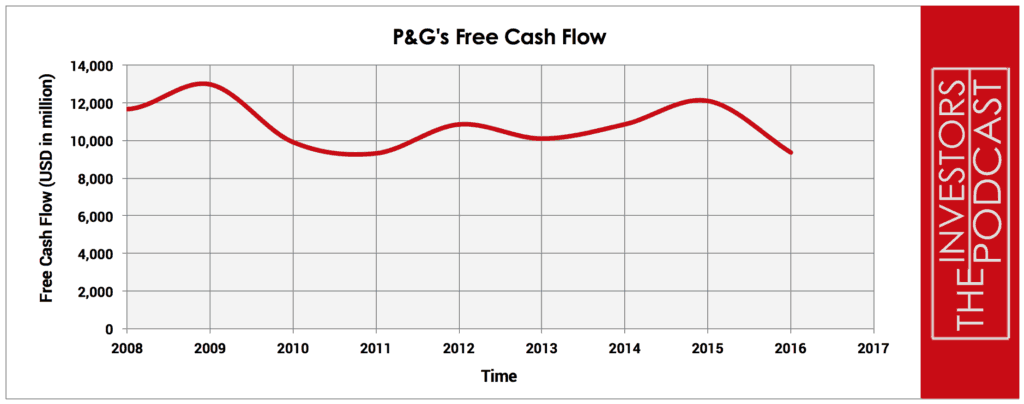
As one can see, the company’s free cash flow has been on a declining trend over the past decade. This is, in part, a consequence of management’s decision to streamline the company. In 2014, P&G announced its intention to drop or sell-off around 100 of its products to streamline its business and focus on its 65 most profitable brands. To capture a more accurate picture of long-term free cash flow growth and account for the recent divestiture of assets, the author has opted to use the annualized average growth rate in free cash flow between 1997-2017 which is 4.68%. To determine P&G’s intrinsic value, an estimate must be made of its potential future free cash flows. To build this estimate, there is an array of potential outcomes for future free cash flows in the graph below.
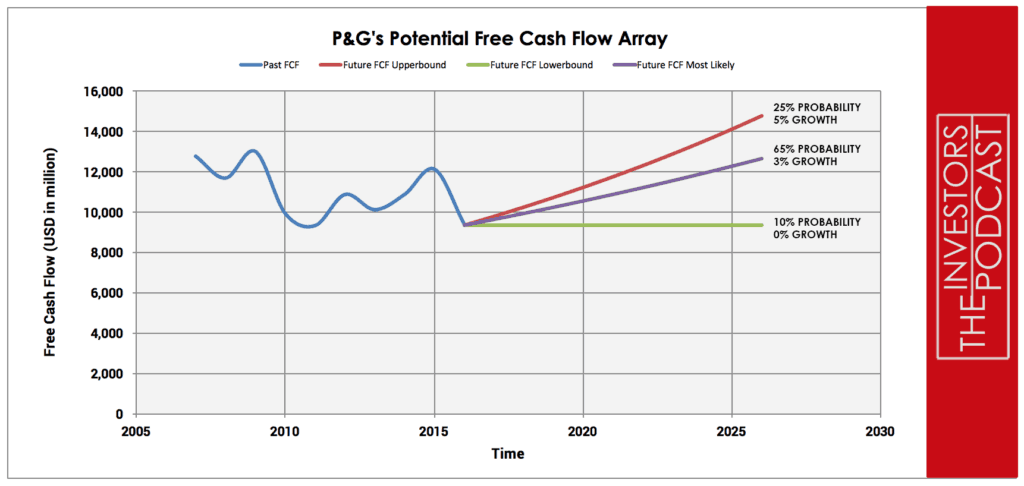
When examining the array of lines moving into the future, each one represents a certain probability of occurrence. The upper-bound line represents a 4.68% growth rate which is based on the company’s historical rate of free cash flow growth referenced above. Since the consumer goods market is currently experiencing slowing growth rates with relatively weak consumer demand, the upper-bound rate has been assigned a 25% probability of occurrence.
The middle growth line represents a 3.04% growth rate which is based on the company’s historical revenue growth rate over the past twenty years. Revenues tend to be far more stable than earnings and offer a more realistic estimate of long-term future growth. For this reason, it has been assigned a 65% probability of occurrence.
The lower bound line represents a 0% growth rate in free cash flow growth and assumes that the company’s growth stagnates over the coming decade in the event of weakening global economic growth. Given that P&G’s products possess strong brand appeal and are likely to be still purchased in a recessionary environment, the author has assigned this outcome a 10% probability of occurrence.
Assuming these potential outcomes and corresponding cash flows are accurately represented, P&G might be priced at a 3.3% annualized return if the company can be purchased at today’s price. We’ll now look at another valuation metric to see if it corresponds to this estimate.
Based on P&G’s current Earnings yield, which is the inverse of its EV/EBIT ratio, the company is projected to return 6.22%. This is marginally above the firm’s 10-year historical median average of 6% suggesting that the company is slightly undervalued relative to its historical average. Finally, we’ll look at P&G’s Forward Rate of Return, a metric devised by Don Yacktman which measures normalized free cash flow plus real growth and inflation. This helps us see what the projected future return might be. At the current market price, P&G is projected to return 4% which is below the firm’s 10-year median average of 6%.
Taking all these points into consideration, it seems reasonable to assume that P&G is trading at a moderate premium to fair value at present. Furthermore, the company may return around 3-4% at the current price if the estimated free cash flows are achieved. Now, let’s discuss how and why these free cash flows could be realized.
The Competitive Advantage of Procter & Gamble Co.
P&G has various competitive advantages outlined below.
- Branding Power. P&G’s most powerful competitive advantage is undoubtedly its portfolio of branded products which include Gillette, Oral B, and Warren Buffett favors companies that derive a competitive advantage from intangible assets, particularly brands, as these are the hardest for a competitor to challenge and tend to foster a high level of customer loyalty. Below is a chart showing P&G’s market share dominance across some product segments

Source: November 2017 P&G Presentation from the Morgan Stanley Global Consumer & Retail Conference
- P&G’s branding power is closely tied to its ethos of innovation. The company’s commitment to R&D, in which it eclipses all competitors, and continuous product development ensures that it is the industry leader in innovation. A measure of the success is the fact that the IRI New Product Pacesetters Report has featured P&G on its list in every year since its inception in 1995. Furthermore, since the first IRI New Product Pacesetters Report, P&G has had 161 products make the top 25 Pacesetters list in non-food categories more than its six largest competitors combined.
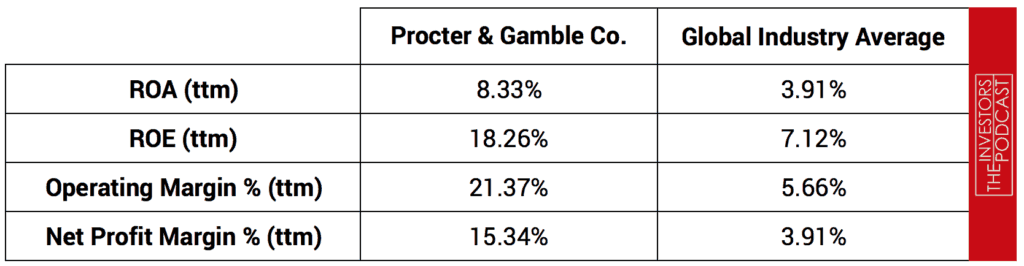
- Scale Advantages. Thanks to P&G’s global presence and a large portfolio of leading brands, the company can operate with economies and efficiencies of scale. At present, the firm reaches over 5 Billion customers in around 180 countries, and as its reach grows, it can drive down operational and production costs to earn industry-beating returns which can be seen in the chart below.
Procter and Gamble Co.’s Risks
Now that P&G’s competitive advantages have been considered let’s look at some of the risk factors which could impair my assumptions of investment return.
- While P&G does possess multiple competitive advantages, there still exists a possibility that one of its rivals or a new entrant could mount a challenge to erode its competitive advantages and move on its market share. A number of these competitors including Colgate-Palmolive, Unilever, L’Oreal, and Kimberly-Clarke possess their own competitive advantages and sufficient capital to mount a serious challenge.
- P&G must ensure it maintains its track record of industry-beating R+D spending in order to maintain a competitive advantage over its peers. Failure to do so would likely result in a narrowing of its market share and a subsequent decline in revenues and profits.
- The emergence of a serious economic crisis similar to that witnessed in 2008 could materially impact the company’s revenues and profits leading to lower growth in the coming years. While P&G’s products tend to be in demand even in recessionary environments, continued wage growth stagnation driven by a decline in global economic growth would likely be detrimental to the company’s economic performance and increase pricing pressure within its market.
Opportunity Costs
Whenever an investment is considered, one must compare it to any alternatives to weigh up the opportunity cost. At present, 10-year treasuries are yielding 2.85%. If we take inflation into account, the real return is likely to be closer to 1%. The S&P 500 Index is currently trading at a Shiller P/E of 33.4x, 98.8% higher than the historical mean of 16.8x. This gives the S&P500 an implied future annual return of -3.3% assuming reversion to the mean occurs. While P&G appears to offer a higher rate of return than both U.S. Treasuries and the S&P 500, other individual stocks may be found which may offer a more favorable return relative to the risk profile.
Macro Factors
Investors must consider macroeconomic factors that may impact economic and market performance as this could influence investment returns. At present, the S&P is priced at a Shiller P/E of 33.4x; This is 98.8% higher than the historical mean average of 16.8x, suggesting markets are at elevated levels. U.S. unemployment figures are at a 30-year low suggesting that the current business cycle is nearing its peak. U.S. private debt/GDP currently stands at 199.6% and is at its highest point since 2009 when the last financial crisis prompted private sector deleveraging.
Summary
The future for P&G looks favorable if it can maintain its competitive advantages and maintain its track record of product innovation and brand development. In recent years, the company has taken steps to streamline the business by drastically reducing its product portfolio from 170 brands in 2013 to its 65 most profitable brands in 2017. The firm has also been focusing on cost-cutting. In between FY’12 and FY’16, they exceeded their target of $10 Billion in savings and grew profit per employee by 45%. FY’17 saw the company generate organic sales growth of 2%, core EPS growth of 7%, and a 94% Free Cash Flow Productivity. The firm is targeting an additional $10 Billion in cost savings over the next four years.
While P&G is making progress in streamlining its business and focusing on its core competencies, it is facing some headwinds. The rate of increase in its customer base is likely to slow down in the future as its products reach saturation point within their respective market segments. To offset this trend of lowering organic growth, the company must expand into new markets, bring new products to markets, and continue to increase its economies and efficiencies of scale.
In the near-to-mid-term, the risk of an economic downturn is a growing concern given the historically high levels of debt present in the global economy. While P&G’s products tend to be in demand in all economic environments, further wage growth stagnation may see consumers turn to lower cost branded products or generic alternatives. Industry-wide pricing pressure may prove to be more powerful than product differentiation through branding power and P&G, along with its peers, will have to continue to adapt to the increasingly fierce competition in the consumer goods industry.
Regarding management’s performance and alignment with shareholders’ interests, historical results have been encouraging. Over the past ten years, the company has returned $120 Billion of capital to shareholders in the form of dividends, and share repurchases have returned nearly $22 Billion in FY’17 alone. The company is targeting around $70 Billion in capital returns through FY’19 and has recently announced a 3% increase in its quarterly dividend. P&G has now risen its annual dividends for the past 61 years consecutively and has consistently paid out capital in dividends for 121 straight years.
At present, P&G appears moderately overvalued on a cash flow basis with an estimated return of around 3-4%. While its current dividend yield of 3.3% is appealing considering the Industry average stands at 2.6%, a more compelling entry point is likely to arise if the global economic outlook weakens.
– – – – – – – – – – – – – – – – – – – – – – – – –
Stig Brodersen is the host of the stock investing podcast “We Study Billionaires.” You can find similar analyses to PG in his free intrinsic value index.
This article was written in collaboration with David J. Flood from “The Investor’s Podcast Network”